The price of support, when the vendor will show you one
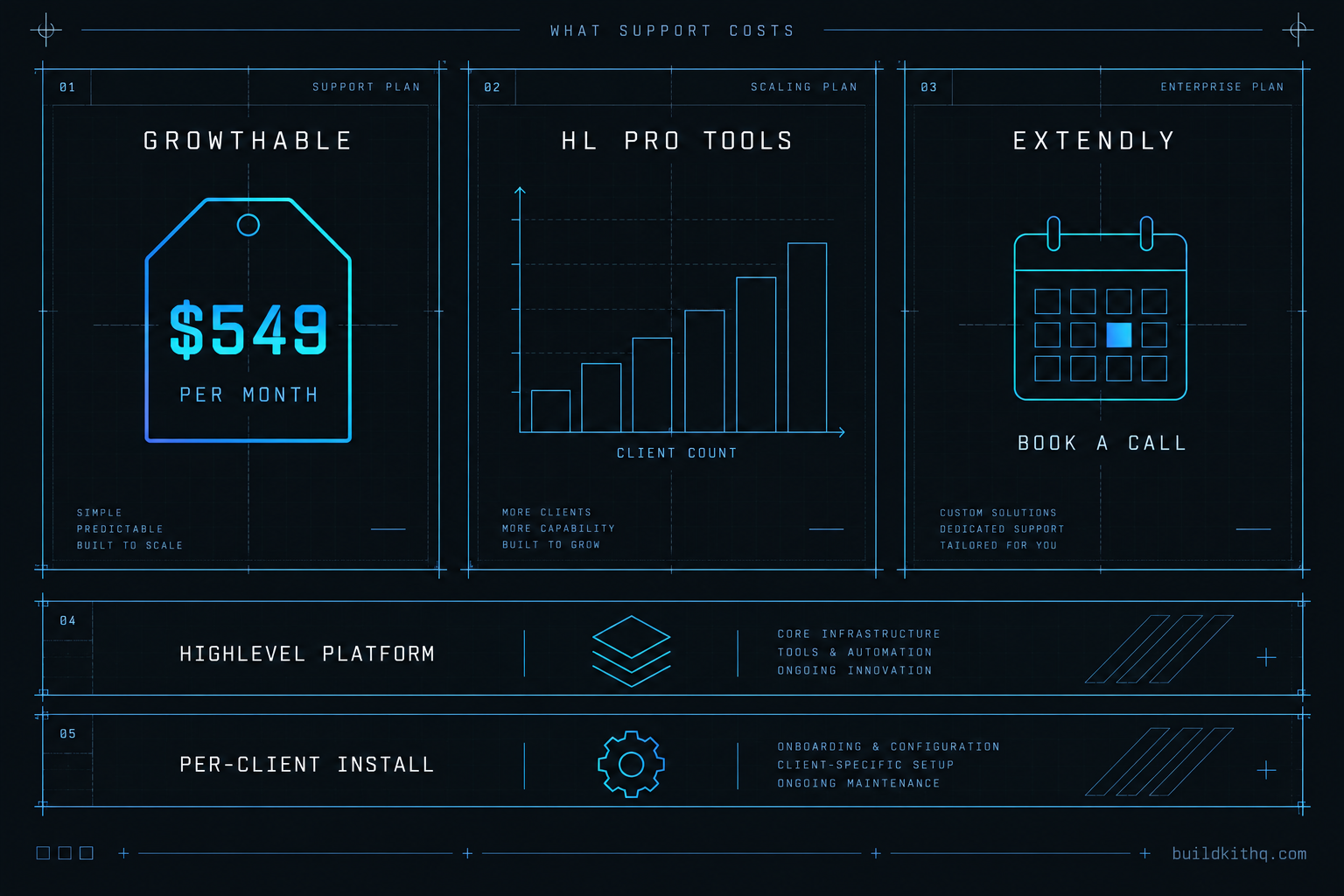
Growthable and HL Pro Tools list a monthly support price. Extendly makes you book a call. Here is what each one buys, and the install bill none of them remove.
It is nine at night and a client has emailed asking why their follow-up stopped going out. You are the entire support department. You always have been, and tonight you finally admit it is not scaling, so you open three tabs to price out buying a team that answers your clients under your name.
The first tab shows a monthly number. The second shows a monthly number too, but it changes depending on how many clients you cover, and you cannot tell from the page which tier you land in. The third has no price anywhere. It has a calendar. To find out what it costs, you book a call with someone whose job is to find out what you can afford before they tell you.
You wanted one column with three prices in it so you could rank them. You have two numbers, one of them conditional, and an invitation to be sold to. This is a guide to reading all three honestly, and to the one cost that sits under every option and that none of the three will take off your plate.
It is deliberately not the same piece as two others on this site. GoHighLevel snapshot pricing is about the shapes a price comes in, one-time against monthly against annual. Reselling a GoHighLevel kit is about what each client install costs you once you own the build. This one does a single job: it prices white-label support, the vendors that sell it, and what the monthly number is and is not buying.
What white-label support actually is
Start by separating three things agencies routinely merge on a spreadsheet, because they are priced differently and bought for different reasons.
The platform is HighLevel itself, the account your client’s funnels and workflows live inside. The build is the set of funnels, workflows, pipelines, calendars, forms and message copy that fills that account. Support is a team answering your clients’ questions about all of it, by ticket and live chat, under your logo, so the client never learns your supplier exists.
White-label support is only the third thing. It is not the account and it is not the build. You are renting people, not software and not funnels. A good support desk takes a client’s “why did my text not send” at nine at night so you do not have to, and it does it in your brand voice on your help center. That is the entire product, and it is worth real money if your client base generates a real stream of questions.
What it is not is an install. When a support vendor onboards you, it answers tickets about accounts that are already built and already live. It does not import your snapshot into a new client, register that client’s A2P 10DLC brand, connect their calendar, or point their phone number at the right workflow. That work is the install, it lands on you per client, and no support subscription in this guide removes it. Hold onto that, because it is the cost that makes two of these quotes look smaller than they are.
Support also sits on a different clock from the build. A build is bought once and kept. Support is rented by the month and billed again on the first, every month, for as long as you keep it. A monthly number is not smaller than a one-time number just because the digits are lower. It is a different shape, and a shape is not a size until you multiply it by the months you will run it.
The three vendors, and whether each shows a price
Three names come up every time an agency asks who answers client tickets under a white label. Here is what each one does with the most basic question a buyer can ask, which is “what does it cost.”
Growthable shows its number
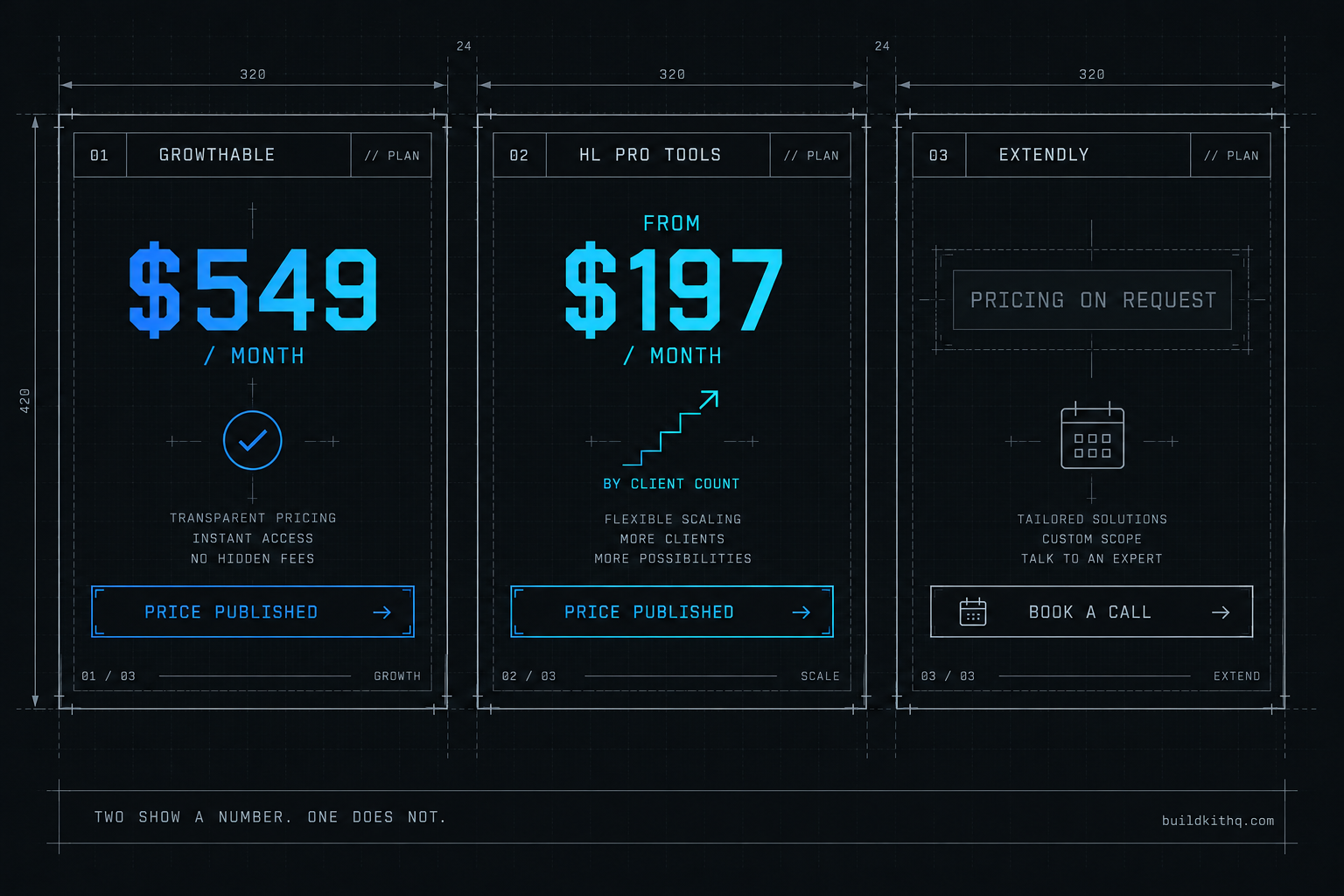
Growthable publishes its support pricing on its own site. As of October 2026, its entry white-label support plan is listed at $549 a month plus a $199 one-time setup fee, and it covers round-the-clock live chat and ticketing for unlimited sub-accounts under your brand, with A2P 10DLC submissions included. A higher tier is listed at $649 a month plus a $99 setup fee and adds a block of onboarding hours each month, then bills overage per hour once those are used. There is a separate AI-only plan listed at $197 a month for an automated help center rather than human agents. You can read those figures on Growthable’s support pricing, which is the point: you can rank it against anything before you talk to a salesperson.
HL Pro Tools shows a number, with a condition
HL Pro Tools also surfaces support-tier prices, but the number moves with how many of your clients it covers. Its entry tier runs around $197 a month for a branded help library and agency-level support, and its fully staffed, round-the-clock, unlimited-client tier climbs toward $997 a month. I read those figures this week from HL Pro Tools’ checkout pages and a third-party vendor comparison rather than from one clean price list, so treat them as the right order of magnitude rather than a quote. The structure is the honest part to take away: you are priced by client count, and the jump from “my agency plus a few clients” to “all of my clients, always on” is the jump from the low hundreds to about a thousand a month.
Extendly makes you ask
Extendly sells a well-regarded full-service support desk, and it does not put a monthly price on it. Its pricing page and the usual comparison pages, checked this week, surfaced no public figure for its managed support tiers. The path is a demo. You book a call, you describe your agency, and a number comes back shaped to what you described. That is a legitimate way to sell, and it is also a wall between you and a comparison. You cannot put Extendly in the column next to Growthable until you have spent the forty-five minutes, and the forty-five minutes is designed to anchor the number to your revenue before you see it. Read the empty price field as “unknown,” not as “expensive,” but budget the call as part of the cost of finding out.
Where the support bill surprises you
The monthly figure, where there is one, is the honest part. The surprises are in the lines beside it. Four of them turn a tidy quote into a bigger annual number than you signed up for, and each is a real cost left off the headline.
The setup fee bolted to the monthly
What you see: a clean monthly number, $549, and you budget twelve of them. What is actually wrong: the first month is not $549. It is $549 plus the $199 one-time setup, and the higher tier carries its own setup fee on top of its own monthly. The fix is to split the quote into a one-time line and a recurring line the way you would read any subscription, then add the setup to month one only. It is not a large number, but it is the difference between the price you remember and the price you pay, and a vendor that buries it is telling you how it treats the rest of the invoice.
The client-count ceiling
What you see: a support tier that fits your agency and your handful of clients, at a comfortable monthly rate. What is actually wrong: the comfortable rate is capped at a number of clients, and the month you win your eleventh client you cross into the next tier, which can be several times the price. HL Pro Tools prices this way on purpose, and it is not hidden, but it is easy to sign up at the low number and forget the ceiling exists until you hit it. The fix is to price the tier you will be in a year from now, at the client count you are actually chasing, not the tier that fits you today.
The overage clock
What you see: a plan that includes onboarding hours, which feels like the install is handled. What is actually wrong: the included hours are a monthly allowance, not a ceiling on the work, and once they are gone the vendor bills by the hour at a rate like $100 an hour, or the AI add-ons meter by the minute once their included minutes run out. If your month is heavy, the overage is where the real number lives, and it is invisible on the pricing card. The fix is to treat included hours as the floor of what you will pay, not the whole of it, and to price a busy month, not an average one.
The install that is still yours
What you see: a support team onboarded, so you feel covered. What is actually wrong: support answers tickets about built accounts. The build and the per-client install are still yours. Every new client needs its own A2P 10DLC brand registered against its legal name and tax ID before a single text sends, its own domain and email configured, its own calendar and number connected, and its own branding swapped in. That work repeats per client whether or not you are paying a support desk, and it is the single most common reason a brand-new client account sits dark on launch day while the support plan bills happily in the background. The fix is to keep the install on its own line, priced per client, and never let a support subscription convince you it is handled. If you would rather hand the registration off each time, A2P 10DLC registration is a standalone job at a fixed $450 per brand on this site, separate from any monthly.
The arithmetic, on one clock
Here is the whole thing on a single clock so the shapes stop fighting each other. The rule is simple: multiply every monthly figure by the months you will run it before you set it beside a one-time number, and keep the platform fee out of the comparison because it is identical under every option.
The platform floor first, because it is the same under all of them. HighLevel publishes three plans. As of October 2026, Starter is $97 a month, Unlimited is $297 a month and is the working plan for an agency running client sub-accounts, and Agency Pro is $497 a month and adds SaaS mode. Every plan carries a 14-day free trial, and paying annually knocks roughly 17 percent off. Unlimited at $297 a month is $3,564 across a year before you buy a funnel or rent a single hour of support. That number is yours whichever row below you choose, so it belongs in your monthly budget and not in this comparison. A quote that folds the platform into one option and not the others is comparing a car to a car payment.
Above the platform, here is the year-one shape of each support route, with the per-client install kept separate because it lands on you in every row.
| Support route | Shows a price up front | Billing clock | Year-one cost before install | Who answers your clients |
|---|---|---|---|---|
| Growthable, entry human support | Yes, on the pricing page | Monthly plus one-time setup | $549 x 12 plus $199 = $6,787 | Their agents, under your brand, round the clock |
| HL Pro Tools, scales with client count | Yes, with a client-count condition | Monthly, tiered | about $197 x 12 = $2,364 at entry, climbing toward $997 x 12 = $11,964 at the top | Their agents, tier depending |
| Extendly, full-service support | No, book a call | Monthly, quoted | unknown until the call | Their agents, under your brand |
| Buy the build instead | Yes, every kit lists its price | One-time | the kit price, once, and it does not renew | You, with the kit’s included install hours |
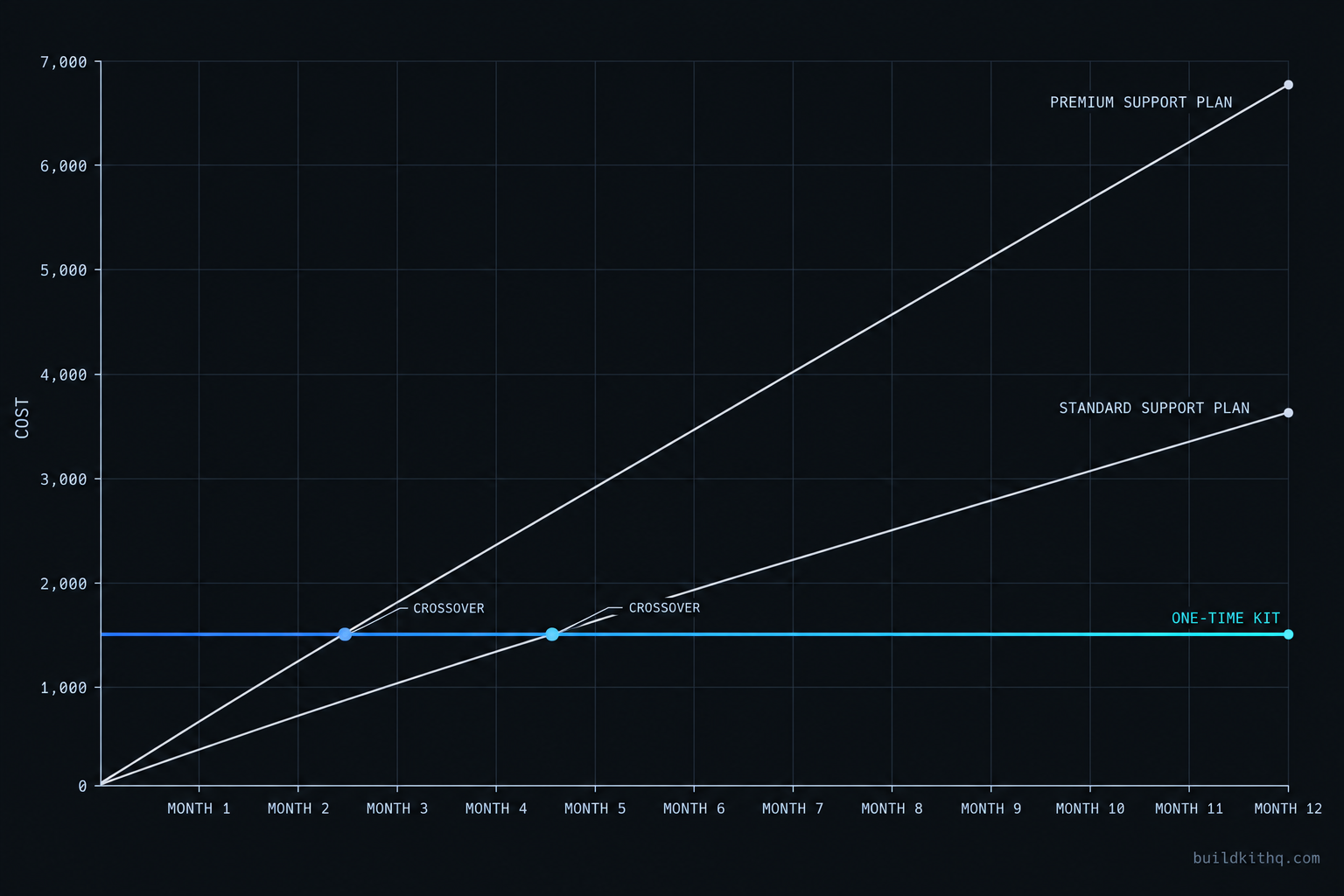
Read the crossings, not the stickers. Growthable’s entry plan at $6,787 in year one is a real team on live chat for your clients all year, and if your clients generate a steady stream of questions that is money well spent. But if what you actually needed was the account built, installed and handed over, you have rented a team by the year to cover a job that finishes in week one. A complete kit is a one-time price. The full BuildKitHQ price list runs from a low end around $875 for the simpler trades to a little under $2,400 at the top, and the number on the page is what you pay, once, with installation free and 10 hours of dedicated installation support included, to be used within 12 days of purchase. The insurance agency kit and the salon and barber kit sit at opposite ends of that band, and both cost less in total than a single year of entry-level rented support, because one renews and the other does not.
If you genuinely need an ongoing team rather than a build, that is a service with a published monthly price too. A white-label agency build on this site starts at $2,400 per month, and it is quoted as a number you can read before you talk to anyone, which is the whole argument of this guide applied to our own rate card. The point is not that monthly is wrong and one-time is right. The point is that you cannot choose between them until both are the same shape and both show you a number.
The objections worth taking seriously
Three arguments push back on all of this, and the strongest versions deserve a straight answer.
“The monthly plan looks cheaper than a one-time kit, so it wins.” It looks cheaper for exactly one month. Growthable’s entry plan is $549 against a kit’s several hundred to a couple of thousand, and the monthly number is smaller at a glance. Keep it a year and it is $6,787, keep it two and it is over $13,000, while the kit you skipped is still its one-time price and always will be. The monthly figure is not a size until you multiply it by the months. Do the multiplication first, then compare.
“A kit can’t answer my clients at nine at night, and a support desk can.” This is the fair one, and it is half right. A support subscription buys an ongoing team, and a kit is not that. If your client base generates a constant stream of tickets and you cannot staff it yourself, a desk earns its recurring fee, and no one-time purchase replaces it. But be honest about which problem you have. If your accounts sit quiet once they are built, you are paying monthly for a team that waits by a phone that does not ring. Rent support for the tickets you actually get, buy the build for the accounts you actually launch, and do not let one solve the other’s problem on the invoice.
“Extendly’s hidden price might be the best of the three, and I’ll never know if I skip the call.” True, and worth saying plainly. A quote-only offer is a price you do not know yet, not a price that must be high, and Extendly’s support has a good reputation. If you have the time, book the call and put the number in the column. Just go in knowing the call is engineered to learn your revenue before it quotes, so decide your ceiling before you dial, and compare whatever comes back against the two published numbers you already have. A price you had to earn with a meeting is still a price, and it still has to beat the ones that were sitting on a page.
None of the three is a mistake. They are three different purchases wearing the same word. Price them on one clock, keep the platform floor in your budget and out of the comparison, keep the per-client install on its own line, and the option that wins is usually the one that was quietly winning before you opened the tabs.
Quick answers
No. A support vendor answers your clients. It does not replace the account they live in. HighLevel Unlimited is $297 a month as of October 2026, and that floor is there whether you rent support, buy a kit, or do everything yourself. Any support quote that leaves the platform cost out is quoting you half a number.
A demo-led sale lets the seller set the number against your revenue rather than against the work. It is not always a trick, but it means you cannot rank it beside a published price until you have spent the call. Read a quote-only offer as a price you do not know yet, not a price that has to be high.
No. Support answers tickets and live chat. The install is a separate job: the A2P 10DLC brand, the rebrand, the calendar and number connections. That work lands on you per client no matter which support plan you rent. A BuildKitHQ kit includes 10 hours of dedicated installation support, to be used within 12 days of purchase, which is the install, not an ongoing team.
Over a year, usually yes, because a one-time price stops after you pay it and a subscription renews every month. But they buy different things. A kit is the build. A support plan is a team answering your clients all year. Plenty of agencies run both, for different reasons, which is why you price them on the same clock before you choose.
Keep reading
What a finished GoHighLevel account does with a lead
A lead moves through five stages in a finished GoHighLevel account. Here is what each stage is wired to, and the handoffs where a half-built one drops it.
Read itThe AI receptionist in your kit answers, but never books
An imported kit's AI receptionist replies around the clock and books no one. Here is the booking path underneath, the four places it breaks, and the fix.
Read itThe four ways to catch a lead your client's phone missed
A missed call is a lost client. Compare the GoHighLevel AI Receptionist, a human VA, missed-call text-back and voicemail on the eight things that matter.
Read it