The kit is a one-time cost. Each install is not.
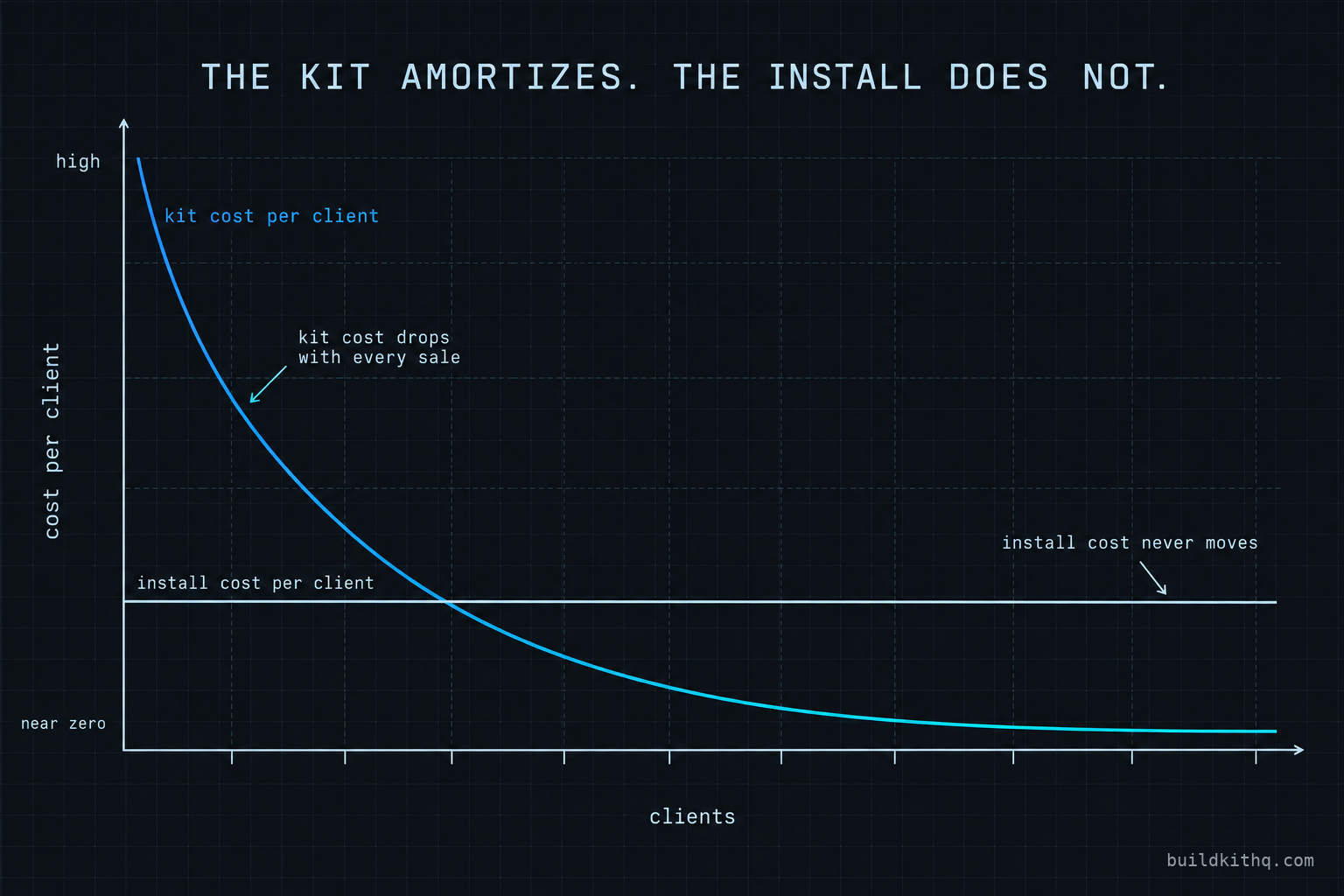
You buy a GoHighLevel kit once, then resell it to client after client. The kit cost amortizes to nearly nothing. The per-client install is where the margin goes.
The fourth time you load the same kit, you expect it to be easy. It is the cleaning-company build, the one you have now sold to three agencies before this one, and you know every screen in it. You import the snapshot into the new sub-account, watch the green bar fill, and start the clock in your head at twenty minutes.
Then the account opens and it is wearing the last client’s clothes. The website header still says Sparkle Pro. A custom value called {{company.owner_cell}} is pointed at a phone number that belongs to a different business in a different state. The booking calendar is connected, green, confirmed, and feeding into a Google account you logged into back in March for client number two. And when you go to send the welcome text to yourself as a test, nothing arrives, because the A2P brand on this account does not exist. You registered one for Sparkle Pro. This client is a separate company with a separate tax ID, and it needs its own.
Twenty minutes becomes most of a day. The kit was free this time, in the sense that you had already paid for it. The day was not. That day is the thing this guide is about, because it is the number almost every reseller leaves out of the math, and it is the number that actually decides whether reselling a kit makes you money.
The cost that spreads, and the cost that does not
Start with the part that works in your favour, because it is real and it is the reason reselling a kit is a good idea in the first place.
A kit is a snapshot file. You buy it once. The cleaning services kit has a one-time price on its page, you pay that price a single time, and from then on you own a snapshot you can load into as many client sub-accounts as you like. There is no per-import fee and no license that counts your seats. Sell the same build to your first client and the kit cost is the whole kit price. Sell it to your fifth and the kit cost per client is a fifth of that. By your tenth it has shrunk to a rounding error against everything else on the invoice. The one-time price is the one cost in this whole exercise that gets smaller every time you use it.
Two of your three recurring costs behave the same way. The platform seat is the second. HighLevel publishes its plans, and as of 5 October 2026 the Unlimited plan is $297 a month and carries no cap on the number of sub-accounts you run under it. That $297 is the same whether you have one client on it or thirty, so the platform cost per client falls as you add clients, exactly like the kit. Agency Pro, at $497 a month, adds SaaS Mode, where you provision sub-accounts automatically and bill clients recurringly under your own brand. Both of those plan prices are a floor you pay once a month, not a tax on each client. These are HighLevel’s own subscription prices for the platform underneath your work, and they have nothing to do with what a kit costs.
So kit cost per client falls. Platform cost per client falls. If those were the only two numbers, reselling would be close to free money after the first sale, and that is exactly the picture most resellers carry in their head when they buy a kit to flip.
The third cost is the install, and it does not spread. It costs the same on your tenth client as on your first, because every client is a fresh account that has to be rebranded, re-registered and reconnected from scratch. The rebrand has to happen again. The A2P brand has to be filed again. The calendars and the phone number have to be wired to this client’s own accounts, not the last one’s. None of that work gets easier or cheaper with volume. It is a flat cost per client, paid in your hours, and it is the only line on the sheet that refuses to amortize.
That is the whole shape of the thing. Your margin on a resold kit is not the sale price minus the kit, because the kit barely costs anything by client five. Your margin is the sale price minus the install, and the install is the number nobody quotes.
What the install actually is, screen by screen
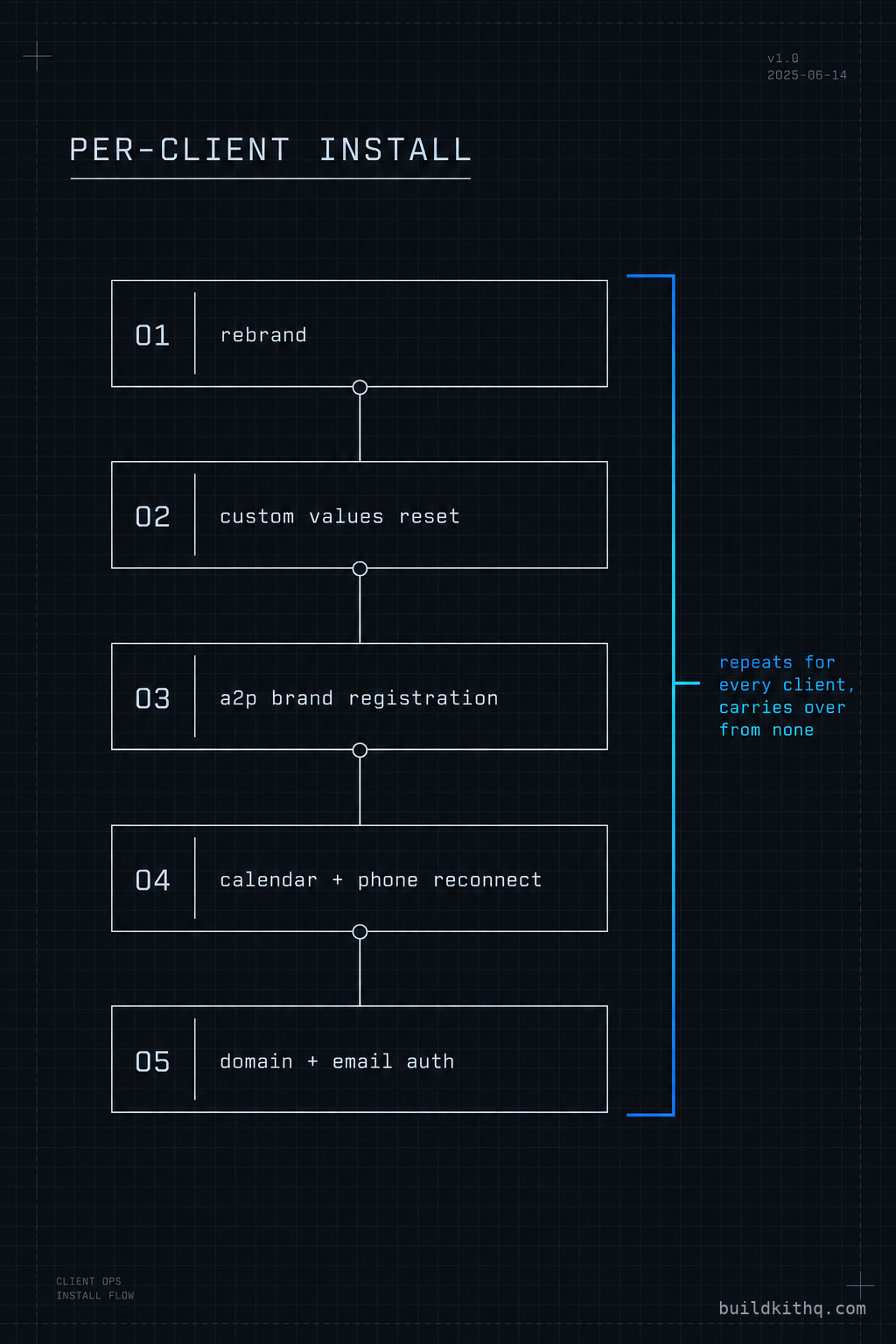
To price the install you have to know what is in it, so here is the per-client work in the order you hit it after the snapshot loads. This is the list that eats the day, and it is the same list every time.
The rebrand. The snapshot carried the business name, logo, colours and copy from whatever account built it, or from the last client you sold it to. All of that lives in more places than you remember: the website pages, the funnel headers, the email footer, the calendar confirmation copy, the custom values that hold the company name and address. You open Sites, then each funnel, then the email templates, and replace the old identity with the new one. Nothing is hard. There is just a lot of it, and missing one spot means a client sees a competitor’s name in their own confirmation email on day one.
The custom values reset. This is the one that bites quietly. A snapshot’s workflows and templates do not hold raw text, they hold references like {{custom_values.booking_link}} and {{custom_values.owner_phone}}. When you load the snapshot, those references carry over but the values they point to are either empty or still holding the last client’s data. You go to Settings, then Custom Values, and set every one of them for this client. Skip it and the automations fire perfectly into the wrong phone number, which is worse than failing, because it looks like it worked.
The A2P brand. You go to Settings, then Phone Numbers, then the Trust Center, and you register this client’s business for A2P 10DLC before a single text will deliver. A brand is tied to a legal business: its registered name, its address, its tax ID, its website. Twilio, which carries the messaging underneath HighLevel, documents the same requirement: the registration is per business, and it was confirmed via search snippets this run rather than fetched directly, but the shape of it is not in dispute and it matches what the Trust Center asks you for. You cannot reuse an approved brand from another client, because it is a different company. Registration is not instant either. It can take days and it can come back rejected for a mismatched address or a thin website, and until it clears, the account is dark.
The calendar and phone connections. The booking calendar has to connect to this client’s own Google or Microsoft account, not the login that happened to be open when you built the thing. You go to Calendars, then Connections, disconnect whatever came across in the snapshot, and connect the client’s account. Then you buy or port this client’s phone number and set it as the account’s sending number. These are account-level connections that a snapshot physically cannot carry, because they are tied to credentials and a purchased number, so they are manual every time.
The domain and email authentication. The site needs the client’s domain, and the sending email needs SPF and DKIM records set on that domain or the first review-request email lands in spam. That is a trip into the client’s DNS, which means waiting on the client to give you access, which is its own small delay.
Add it up and the honest floor for a clean install, on a complete kit where you are only rebranding and connecting, is a solid half day to a full day of focused work. On an incomplete kit, where the workflows reference values that do not exist and you are rebuilding rather than rebranding, it is two or three times that, and some of those hours are spent discovering problems rather than fixing them. The completeness of the kit is not a quality nicety. It is the multiplier on the only cost that does not amortize, which makes it the single most important thing about a kit you intend to resell.
Four ways the margin quietly disappears
Every reseller who loses money on a kit loses it in one of these four ways. None of them is exotic. All of them come from pricing the amortizing costs and forgetting the flat one.
Charging a flat setup fee that does not cover the hours
You quote the client a setup fee, say a round number that felt fair, and you treat the kit as the cost it covers. But the kit is nearly free by now. The real cost of that setup is your install hours, and if the fee was built around the kit price rather than the labour, you are doing most of a day of skilled work for whatever is left after the kit, which by client five is almost the entire fee and by client ten is more than you charged. What you see is a healthy-looking setup fee. What is actually wrong is that you costed it against the wrong line. The fix is to price every setup against the install hours at your real rate, and let the amortizing kit cost be the bonus it genuinely is, not the thing the fee is sized to.
Assuming the A2P brand carries over
This is the one that turns a twenty-minute job into a launch delay. You registered A2P for the last client, it works, texts send, so you assume the next account inherits it. It does not. The brand belongs to the previous company. The new client is a new legal entity and starts registration from zero, which means days of waiting baked into a launch you may have already promised. What you see is a working messaging setup on the account you built last week. What is actually wrong is that nothing about that approval is portable. The fix is to start the A2P registration on day one of every client, before the rebrand and before anything else, so the days of carrier review run in the background while you do the rest. If you would rather hand that part off entirely, A2P 10DLC registration is a fixed $450 per brand on this site, which is also a clean way to see what the per-client cost of that one step really is.
Reselling the account with the last client still in it
You skip the custom-values reset because the automations “already work,” and they do, into the previous client’s data. The owner’s cell in a custom value is still the last owner’s. The pipeline stage names still say Sparkle Pro’s internal language. The demo calendar is still booking into your own Google account from March. What you see is a green, functioning account that passes a glance. What is actually wrong is that it is wearing the previous client’s identity under the hood, and the first real lead routes to the wrong phone. The fix is a hard reset pass on every custom value, every connection and every piece of identity copy before handover, which is exactly the QA pass a snapshot needs before a client ever logs in, run fresh for each resale rather than once for the kit.
Treating the platform seat as a per-client cost
The opposite mistake, and a cheaper one, but it still skews the decision. You see $297 a month and mentally attach the whole thing to each new client, so each client looks less profitable than it is. In fact that seat covers all your sub-accounts at once, so its share per client falls as you grow, the same as the kit. What you see is a big recurring platform bill. What is actually wrong is that you are dividing a shared cost as if it were a dedicated one. The fix is to hold the platform as a single fixed line in your own overhead, divide it across your whole client base when you want a per-client figure, and keep it out of the install math entirely, because it is not part of the per-client work.
The arithmetic, on one client at a time
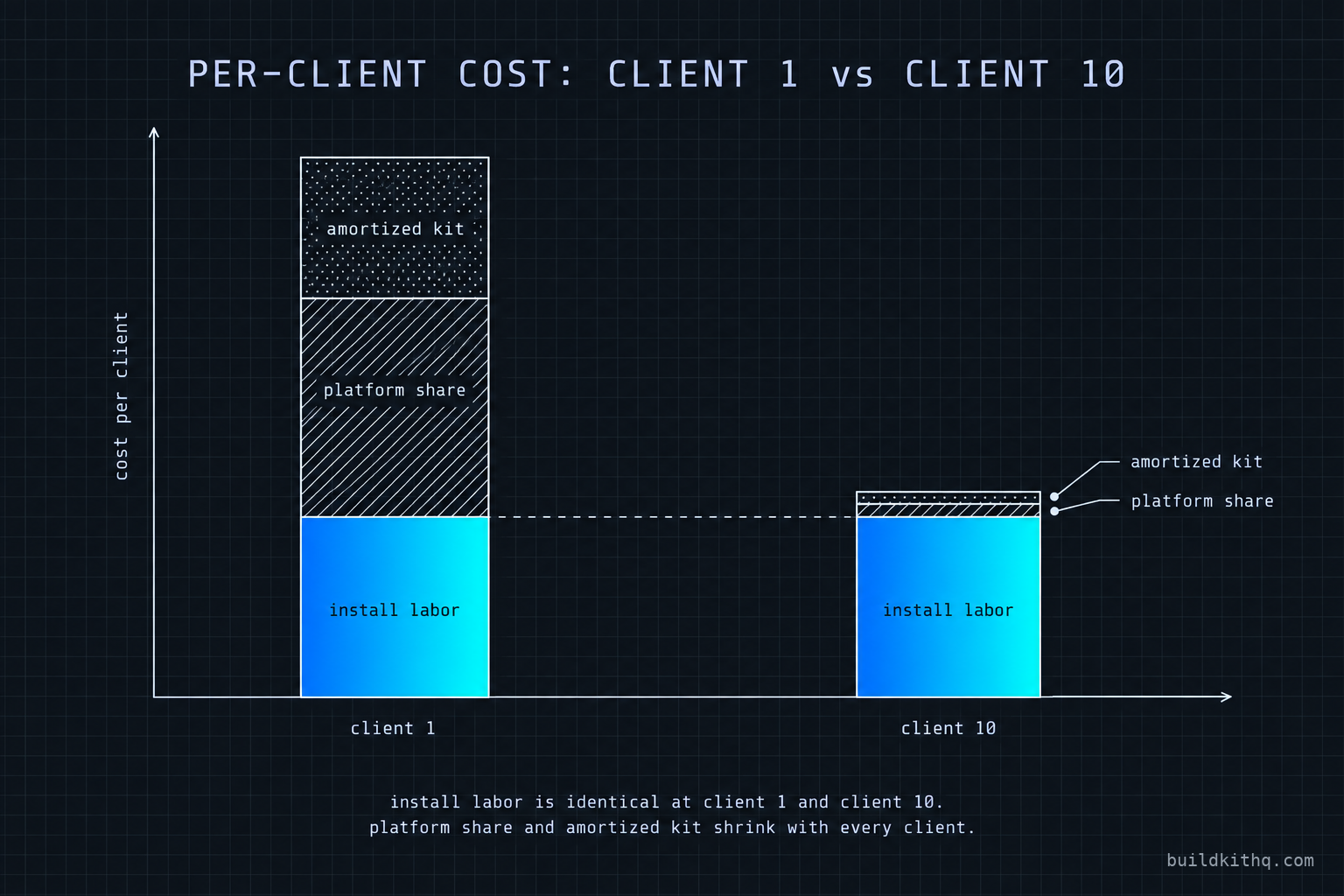
Here is the whole thing laid out, so the flat cost and the shrinking ones sit next to each other and stop arguing.
Assumptions, printed so you can swap your own in. One agency. One kit owned, bought once at its published one-time price. HighLevel Unlimited at $297 a month as the platform, shared across every client. An effective build rate of $75 an hour, which is a placeholder, not a claim about your business, so put your own rate in its place. A complete-kit install costed at eight hours of focused work, and a half-built install at twenty, which are illustrative round figures for the shape of the thing, not a measured promise. A2P either done in-house inside those hours or outsourced at the $450 per brand this site charges. Usage fees for texts and calls are left out of the setup math because they are ongoing, not install costs, though they are real and I come back to them below.
The point of the table is not the exact dollars. It is which numbers move as you add clients and which do not.
| Per-client cost line | At client 1 | At client 5 | At client 10 | Does it amortize? |
|---|---|---|---|---|
| Kit, one-time price divided by clients so far | full kit price | one fifth of it | one tenth of it | Yes, fast |
| Platform seat share, $297 a month over your clients | $297 | about $59 | about $30 | Yes |
| Install labour, 8 hours at $75 | $600 | $600 | $600 | No |
| A2P brand, if outsourced | $450 | $450 | $450 | No |
Read the last column, not the numbers. Two lines shrink toward nothing and two lines hold flat. By client five, the kit and the platform share together are smaller than a single hour of your install time, and the entire economics of the resale have collapsed down to one question: what does the hands-on install cost, and does the client’s fee clear it.
That is why a complete kit matters more to a reseller than a cheap one. Swap the eight-hour install for a twenty-hour one on a half-built snapshot and the install line jumps from $600 to $1,500 at the same rate, and it jumps on every single client, forever. The cheaper kit that needs rebuilding does not save you money. It raises the one cost that you pay again on every resale, which is the most expensive mistake available here. This is the same reason building from empty is rarely the bargain it looks like: the hours are the cost, and a complete starting point is the only thing that lowers them.
Now the fee. Set it against the flat lines, not the shrinking ones. If your install is a day and your rate is real, the setup fee has to clear the install labour plus the per-brand A2P before it is profit, and the kit cost is genuinely a bonus that improves with every client. On the recurring side, the monthly retainer you charge sits on top of the platform seat, and the usage fees for messaging pass through on top of that. Those carrier fees are small per message but real: reported figures this run, confirmed via search snippets rather than a direct read, put the per-message carrier charges around $0.0045 on T-Mobile, $0.0040 on Verizon and $0.0030 on AT&T, with T-Mobile’s rate having risen at the start of 2026. On Agency Pro you can mark those up and rebill them, which is a separate revenue line from the install and worth its own column in your own spreadsheet. The full kit price list is on one page if you want to run these numbers against real one-time figures rather than placeholders.
The objections worth taking seriously
Three arguments push back on all of this. The strongest versions are worth answering, including the one that argues against buying a kit from us at all.
“The setup fee is a one-time charge to the client, so my hours do not matter.” They matter precisely because the fee is one-time. A recurring retainer forgives an expensive setup over months of billing. A one-time setup fee has exactly one chance to cover the work, and if it was sized to the kit rather than the install, it does not. The honest test is simple: take the fee, subtract your install hours at your real rate, subtract the per-brand A2P, and see what is left. If the answer is a thin positive number on client one, it is a thin positive number on client ten too, because the install never got cheaper. The hours are the cost whether you look at them or not.
“I will just reuse the A2P brand and skip the re-registration.” You cannot, and the reason is not a HighLevel setting you can toggle. A2P 10DLC brands are tied to a business identity at the carrier level, its legal name and tax ID, because the entire point of the system is to attach a real company to the messages its account sends. Loading one client’s approved brand onto another company’s account is not something the platform offers, and attempting to send a different business’s traffic through it is the kind of thing that gets numbers filtered. The re-registration is not busywork. It is the one step that keeps the client’s texts arriving at all, which is why skipping it is how a resold account ends up dark on launch day.
“If the install is the real cost, why buy your kit? I should build one build and reuse it forever.” Sometimes you should, and here is the honest case for it. If you have settled on a single niche, you have built its account cold before, and you will resell the same build many times, then building your own snapshot once and flipping it is a sound plan, and the install math above applies to your own build exactly as it applies to ours. The thing to notice is what that argument does and does not change. It changes who owns the kit. It does not change the install, because a snapshot you built yourself still carries your last client’s data, still needs a fresh A2P brand per company, and still needs every connection rewired. The per-client install is identical whether the kit is ours or yours. What a complete kit buys you, built by anyone, is a lower install cost on every resale, because there is nothing to rebuild, only to rebrand and connect. If you have the niche nailed and the week to spare, build it. If you would rather skip straight to a complete starting point and spend your hours on the resale rather than the rebuild, that is what a kit priced for reselling is for, and if you would rather not touch the installs at all, the white-label agency build exists to take them off your desk.
None of this makes reselling a kit a bad business. It is a good one, and the kit amortizing to nearly nothing is exactly why. The mistake is reading the shrinking costs, feeling the margin, and pricing as if the install shrank too. It does not. Price against the flat line, start the A2P clock on day one, reset every account to the new client before handover, and the resale that looked like free money after the first sale turns out to be real money on every sale, which is the better outcome anyway.
Quick answers
Yes. A kit you own is a snapshot you can load into as many client sub-accounts as you want, and the one-time price is paid once no matter how many times you import it. What you cannot reuse is the install. Every client needs its own rebrand, its own A2P brand, and its own calendar and phone connections, and that work repeats with each one.
Yes. A2P 10DLC brand registration is tied to a business, its legal name and its tax ID, so each client registers its own brand before its texts will send. You cannot carry one client's approved brand onto the next account. This is the single most common reason a resold kit sits dark on launch day.
Your time, the platform seat, and the per-brand A2P work. The kit is a fixed one-time price that spreads thinner with every client you sell to. The install does not spread. It costs the same hours on your tenth client as on your first, which is why a complete kit that needs only rebranding is worth more to a reseller than a cheap one that needs rebuilding.
On Agency Pro at $497 a month, SaaS Mode lets you provision sub-accounts automatically and bill clients recurringly under your own brand, per HighLevel's published pricing on 5 October 2026. The kit is what fills each new account. SaaS Mode handles billing and provisioning; it does not do the per-client install for you.
Keep reading
What a finished GoHighLevel account does with a lead
A lead moves through five stages in a finished GoHighLevel account. Here is what each stage is wired to, and the handoffs where a half-built one drops it.
Read itThe AI receptionist in your kit answers, but never books
An imported kit's AI receptionist replies around the clock and books no one. Here is the booking path underneath, the four places it breaks, and the fix.
Read itThe four ways to catch a lead your client's phone missed
A missed call is a lost client. Compare the GoHighLevel AI Receptionist, a human VA, missed-call text-back and voicemail on the eight things that matter.
Read it