What a finished GoHighLevel account does with a lead
A lead moves through five stages in a finished GoHighLevel account. Here is what each stage is wired to, and the handoffs where a half-built one drops it.
A roofing client called us on a Monday with a fair question we could not answer from the dashboard. A homeowner had filled out the storm-damage form on Friday evening. By Monday the lead had gone cold, and the client wanted to know where in the account it had stalled. We opened the sub-account and looked. The form had a submission. A contact existed. There were live workflows, a calendar, a pipeline with stages, and a review request sitting in a folder. Every part was present. Not one of us could say, from looking, what was supposed to have happened to that homeowner between Friday night and Monday morning.
That is the gap this guide is about. An imported account is a pile of correct parts. A finished account is those parts wired into a relay, where each one hands the lead to the next and the lead never touches the floor. The parts are the easy bit. The handoffs are where the money is, and the handoffs are exactly what does not survive an import, because they depend on things the snapshot was never able to carry.
So here is the whole machine, stage by stage. What each stage is, what it is wired to, and the five places a half-built account drops the lead on the way through. By the end you will be able to answer the roofing client’s question about any account in front of you, in about two minutes, without guessing.
The account is a relay, not a pile of parts
Think about one lead, not the feature list. A lead is a contact record that moves. It enters the account somewhere, it changes state as things happen to it, and at each change something is supposed to pick it up and carry it forward. The funnels, workflows, pipelines and calendars are not the system. They are the stations the lead passes through. The system is the set of handoffs between them, and a handoff in GoHighLevel is almost always one of three things: a tag written onto the contact, a pipeline stage it moves into, or an appointment status that flips. Those three signals are the baton. Everything waits on one of them.
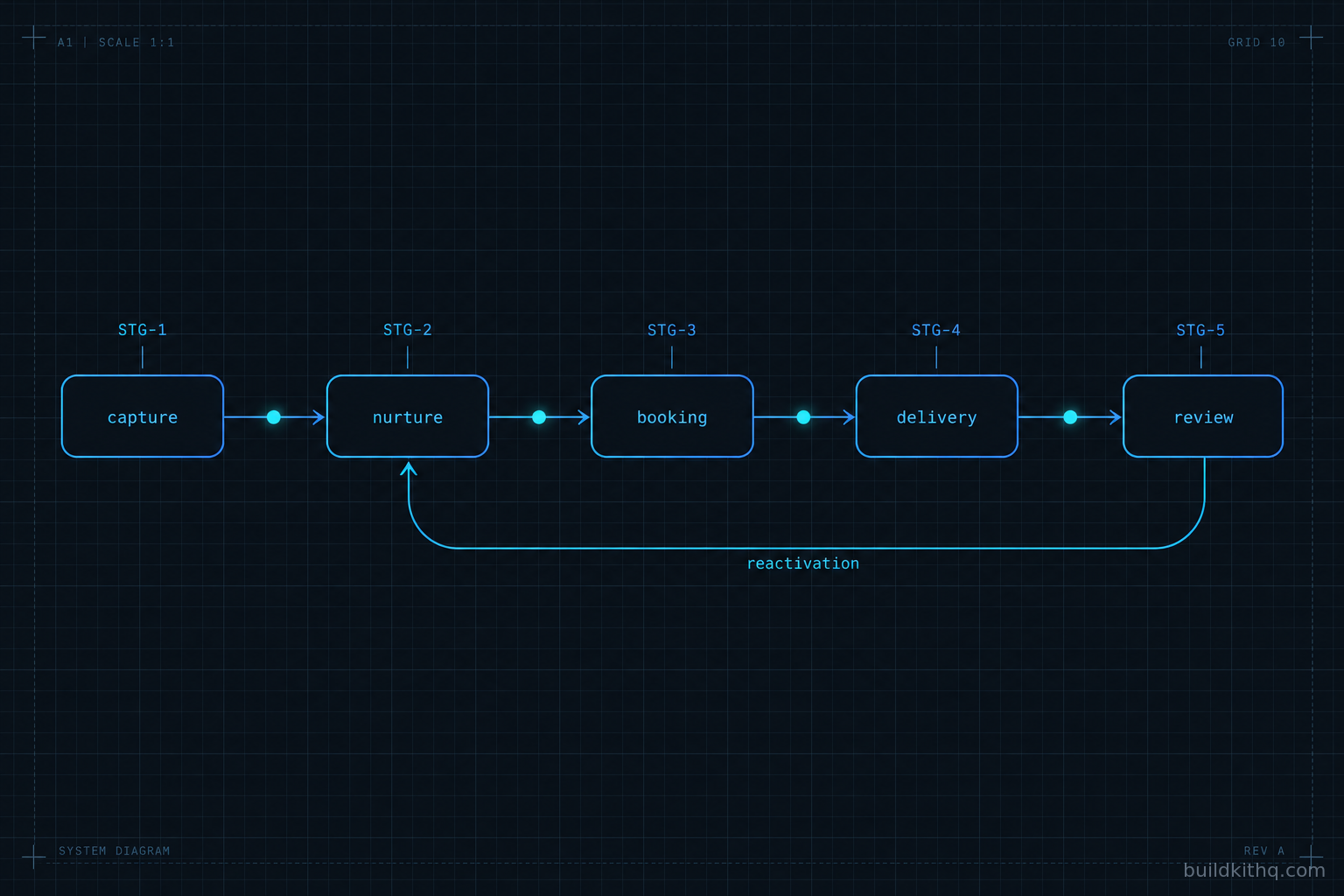
Once you see it that way, the account stops being a screen full of green toggles and becomes a route with five legs. A lead gets captured. It gets nurtured until it is ready. It books. The work gets delivered while the opportunity moves through a pipeline. And at the end it gets asked for a review, which also wakes up the dead leads and sends them back to the start. Five legs, and a loop at the end that feeds the front.
Every leg hands to the next on a signal. Miss the signal and the lead sits at a station forever, which from the client’s chair looks exactly like the earlier station failed. That is why the roofing lead was impossible to place by eye. A lead stuck between capture and nurture and a lead stuck between booking and delivery look identical on the contact record. Both are just a name sitting still. You have to know which handoff owns it.
What each of the five stages is wired to
Here is each leg, in order, and the specific thing in the account that drives it. This is the map. The next section is where it breaks.
Stage one: capture
Capture is the funnel, the form or the website turning an anonymous visitor into a contact record. In our roofing example it is the storm-damage form on the landing page. When it submits, three things have to happen at once, and only one of them is visible. The contact is created, which you can see. A source is recorded, so you know later that this lead came from the storm funnel and not a referral. And a tag or a trigger fires that tells the rest of the account a new lead just arrived. That third thing is the baton for the whole relay. Capture’s real job is not collecting a name. It is raising a hand.
Stage two: nurture
Nurture is the cadence that works the lead from the second it is captured until it is ready to book. It has two parts that people collapse into one and should not. The first is the immediate reply, the speed-to-lead text and email that go out inside a minute of the form fill, because the odds of reaching a lead fall off a cliff fast. Harvard Business Review’s audit of first-response times found the average firm took around 42 hours to respond and that reaching a lead inside the first hour made a real conversation far likelier. The second part is the longer drip: a few messages across several days, alternating channel, that keep offering the next step until the lead takes it. Stage two is wired to the capture tag, to a sending number that can actually text, and to a suppression layer that pulls a lead out the moment it replies, books, or opts out.
Stage three: booking
Booking is the calendar and the workflow around it. The nurture cadence has been pushing toward one action, and that action is a booked appointment. When the lead picks a slot, the calendar writes an appointment, the appointment confirmation goes out, and a reminder sequence starts: a day before, a few hours before, and for a service business, a recovery branch for the ones who do not show. No-show recovery is the single most valuable automation in most accounts, which is why the build target for it is to claw back up to 70 percent of missed appointments. Stage three is wired to the calendar’s connection to real staff availability, and to the appointment status, which is the next baton.
Stage four: delivery
Delivery is the pipeline. A booked lead is now an opportunity, and the opportunity moves through stages as the work happens: booked, confirmed, in progress, done. Each stage move is a signal the team acts on and a signal other automations listen for. Internal notifications fire so a human picks up the job. The contact gets the operational messages that belong to an active customer rather than the sales cadence, which should have gone quiet by now. Stage four is wired to the pipeline stage changes, and the last of those, the move into done, is the baton for the final leg.
Stage five: review and reactivation
Review is the ask at completion, triggered by the pipeline hitting done or an appointment marked showed. A finished account asks for a review at the one moment the customer is happiest, routes the happy ones to a public listing and the unhappy ones to a private inbox, and does it consistently enough to target five to ten reviews a month for an active local business. The same stage runs the other way too. Dormant contacts, the leads that never booked and the customers who went quiet, get pulled into a reactivation campaign that drops them back into nurture. That loop is why the relay has no end. Stage five feeds stage two, and a finished account recycles its own list instead of only ever buying new leads.
| Stage | What it is | Wired to | The baton it hands forward |
|---|---|---|---|
| Capture | Funnel, form, website | Source tracking, the new-lead tag | A tag that says a lead arrived |
| Nurture | Speed-to-lead reply plus the drip | The capture tag, a sending number, suppression | The lead asking to book |
| Booking | Calendar and reminder sequence | Real staff availability, the calendar connection | The appointment status |
| Delivery | The pipeline | Stage moves, internal notifications | The move into done |
| Review | Review ask plus reactivation | The done stage or a showed appointment | A review, and dormant leads back to nurture |
The five handoffs where a half-built account drops the lead
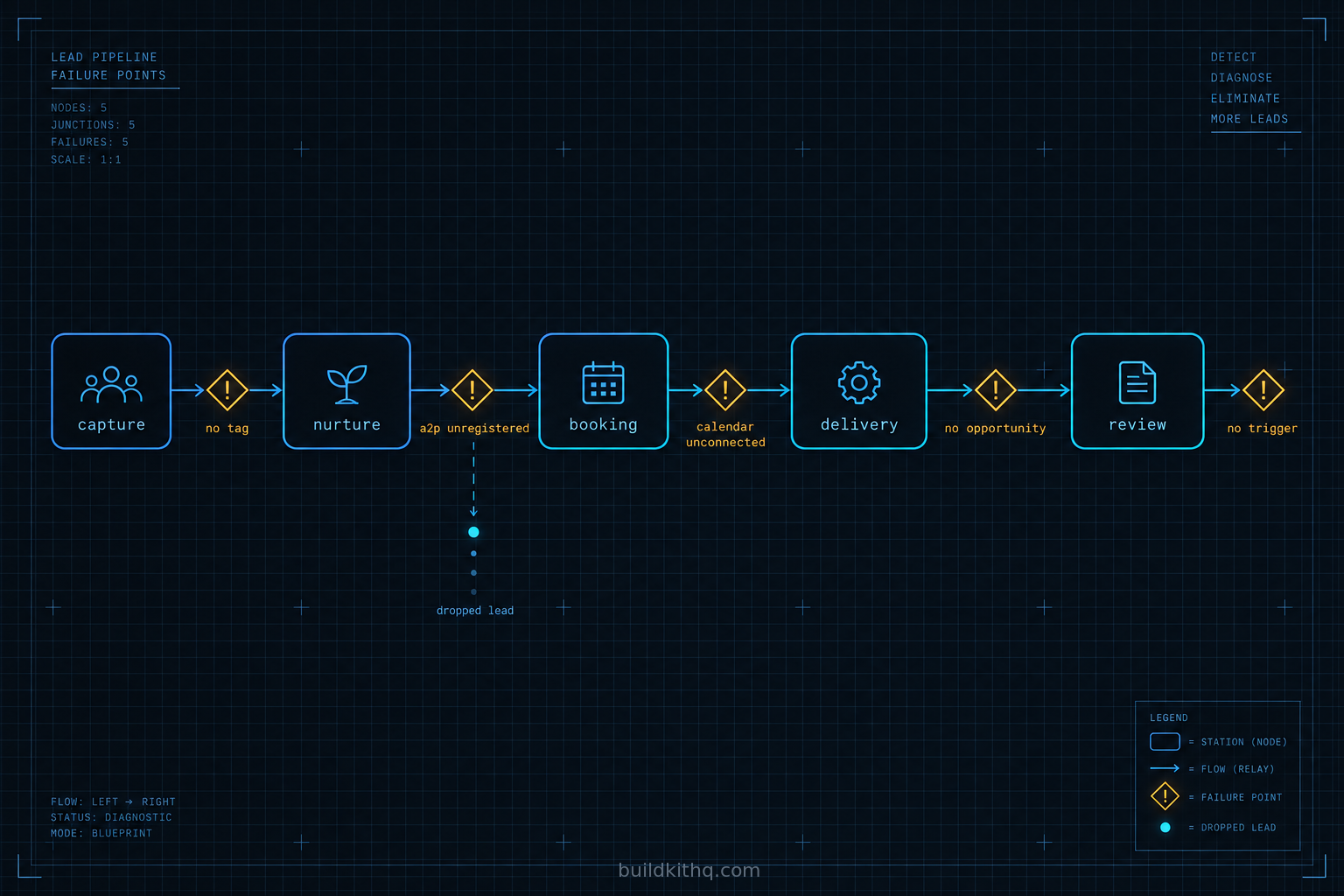
Every one of these is a handoff, not a part. The part on each side imports fine. The signal between them is account infrastructure, and it starts empty. Here is what each break looks like, what is actually wrong, and the fix.
Capture to nurture: the tag that never gets written
What you see: forms have submissions, contacts exist, but the nurture cadence has nobody in it. The lead was captured and then nothing happened. What is wrong: the form or funnel step that is supposed to apply the new-lead tag, or the workflow trigger that listens for it, did not survive the import with the right reference. The funnel points at a tag the workflow is not watching, or the trigger filter is looking at a pipeline or source that does not exist in this account. The baton is dropped at the first handoff, which is the most expensive place to drop it, because you paid for every one of those leads. The fix: submit a real test through the live funnel, open the contact, and confirm the tag landed and the workflow enrolled it. Do not test the workflow in isolation. Test the handoff. We wrote a full diagnosis of funnels that capture and then do nothing if this is where yours sticks.
Nurture that never sends: the dead A2P number
What you see: the lead enrolled in the cadence, the workflow log is green, every send action reads complete, and the client still says nobody heard back. What is wrong: the sub-account’s sending number is not registered for A2P 10DLC, so US carriers filter every text at the network edge. The workflow did its job. It built the message and handed it off. There was nowhere to send it. This is the single most common reason an imported account looks finished and produces silence, and it is invisible from the workflow log because the log stops the instant the message leaves. The fix: read the status on the individual message in the contact’s Conversations tab, not the workflow log, and register the brand and campaign for the sub-account. Email has its own quiet version of this, where an unauthenticated domain lands every message in spam. The send-path breakdown covers both end to end. While you are in the cadence, confirm it respects quiet hours: the federal baseline most compliance guidance treats as the floor is 8am to 9pm in the recipient’s local time, and some states are tighter.
Nurture to booking: the calendar pointed at nothing
What you see: the cadence runs, leads click through to book, and either the calendar shows no availability or it books into a slot nobody is actually free for. What is wrong: the calendar in a snapshot imports its rules, its durations and its reminder workflows, but not its connection to a real person’s availability. That connection is an integration with a specific staff account, and it is blank until someone in this sub-account connects it. A calendar pointed at the wrong availability, or at a previous build’s connected account, is worse than no calendar, because it takes the booking and then no one is there. The fix: connect each calendar to the real team member, set the true working hours, and book a test appointment to confirm the hold, the confirmation and the first reminder all fire. The imported-calendar failure has its own full walk-through.
Booking to delivery: the opportunity that never gets created
What you see: appointments are booking cleanly, but the pipeline is empty and the team does not know a job came in. What is wrong: the workflow that is supposed to create an opportunity in the delivery pipeline when an appointment is booked either did not import its pipeline reference or is pointed at a stage that does not exist in this account. The lead booked and then fell out of the relay, because the baton for the delivery leg, the opportunity moving into the first pipeline stage, was never handed over. The job sits as a calendar entry with no operational wrapper around it, and whether it gets worked depends on somebody noticing it by hand. The fix: confirm the booking workflow creates an opportunity in the right pipeline and stage, and that the internal notification actually reaches a human who acts on it.
Delivery to review: the post-job trigger that never fires
What you see: work is getting done, opportunities move through the pipeline, and no review requests ever go out. The client is delivering good service to quiet customers and wondering why their listing never grows. What is wrong: the review request is triggered by the pipeline reaching its done stage or an appointment being marked showed, and if the team is not moving opportunities to done, or the trigger is watching a stage that got renamed on import, the ask never fires. This is the handoff people skip entirely, because it does not stop money coming in today. It stops the one free growth channel a local business has. The fix: wire the review trigger to the exact done stage this account uses, and make moving a job to done a habit the team actually has, because the automation can only fire on a signal someone sends.
What the whole system costs to run, and what one stage is worth
The relay runs on top of a GoHighLevel subscription, and that is a real line item worth naming before the stage math. The two tiers that matter for an agency, checked against GoHighLevel’s pricing page this week, are Unlimited at $297 a month or $2,970 a year, which removes the sub-account cap so you can run client accounts, and Agency Pro at $497 a month or $4,970 a year, which adds the SaaS mode you need to resell the platform under your own brand. There is a 14-day trial on both. Message and call usage is billed on top of whichever plan you pick, so the plan fee is the floor, not the ceiling. Those are HighLevel’s prices for the platform the kit runs on. They have nothing to do with what a kit costs.
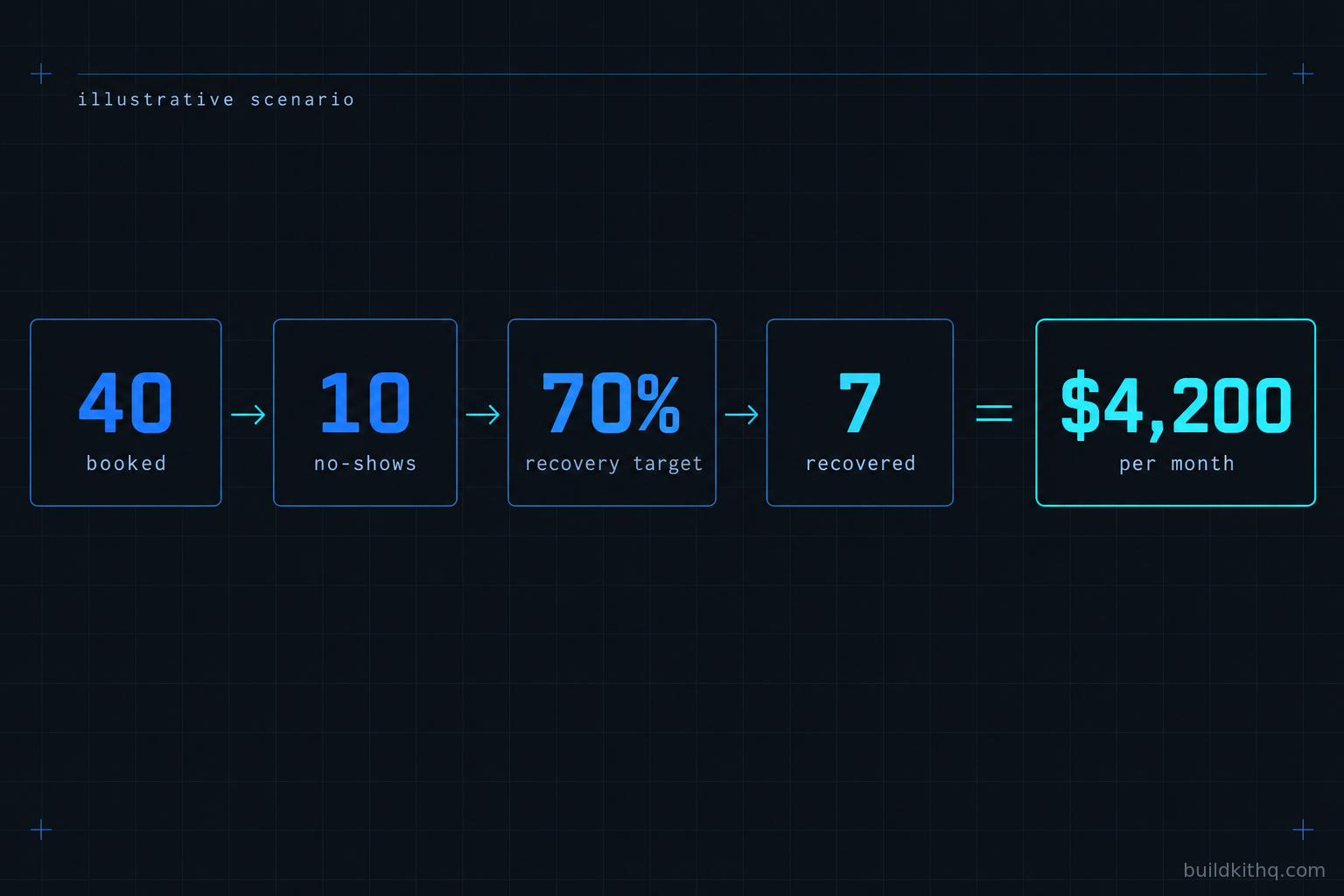
Now the part that actually decides whether the build pays for itself, which is what one working stage is worth. Use your own numbers here; the point is the arithmetic, not these inputs. Say a home-services account takes 40 booked consultations in a month and a quarter of them no-show, which is 10 missed appointments. Stage three’s no-show recovery is built to a target of reclaiming up to 70 percent of those, which is 7 appointments walked back from gone. Put an average job value of $600 on them and that single branch of a single stage is aiming at 7 times $600, or $4,200 of work a month that a half-built account would have let evaporate. Change the job value to $1,500 for a higher-ticket trade and the same branch is chasing $10,500.
Run the same logic on stage five. If the review ask fires reliably and a local business lands five to ten new reviews a month, that is the difference between a listing that climbs the local pack over a quarter and one that stays invisible, which feeds straight back into cheaper leads at stage one. Neither of these is a promise of a result. The 70 percent and the five to ten are design targets the build aims at, and they only happen if the handoffs they depend on are connected. That is the whole argument for treating the account as a relay. A stage that is built but not wired is worth exactly zero, no matter how good the workflow inside it looks. If you want the full rate card for the kits that ship these stages pre-built, it is on the pricing page.
The objections worth answering
“I do not need all five. I will just buy an AI receptionist and be done.” An AI receptionist is stage two and part of stage three in one tool, and it is genuinely good at them. But a receptionist that books into a calendar pointed at nobody, or hands a won lead to a pipeline that does not exist, is answering the phone into a void. The receptionist is a strong station. It still needs the handoffs on either side of it, or it books appointments the account then drops. Buy the receptionist. Just do not mistake one excellent station for the relay.
“My snapshot already imported all of this, so the account is finished.” The content imported. The infrastructure did not, and cannot, because it is specific to the sub-account. Every stage you can see in the builder is real, and every handoff that stage depends on, the A2P registration, the calendar connection, the sending domain, the trigger tags that match this account’s pipeline, is blank until someone connects it. An imported account is a finished-looking account that has not been switched on. The walk-through above is the switching-on, and it is the same work whether you built the stages or bought them.
“This is just a long argument for buying your kit.” It is not, and the honest version helps you more than a pitch would. You can build all five stages yourself. Nothing here is proprietary, and an operator who knows the platform can wire the whole relay given a free weekend or two. What a kit sells is the weekend back, with the stages already built for a specific trade so you are connecting infrastructure rather than designing cadences from a blank workflow. Either way you do the connecting, because no snapshot on any platform ships your client’s A2P registration or calendar. If you would rather hand the whole thing over, that is what done-for-you GoHighLevel setup is, and a kit is delivered within 24 business hours of purchase confirmation with 10 hours of dedicated installation support, to be used within 12 days of purchase, which is enough to connect every handoff in this guide. The relay is the same five stages regardless of who assembles it. The roofing kit and the dental practice kit are the same five stages written for two very different trades.
“Five stages is over-engineering for a small account.” The five are the same at any size. A one-location business running ten leads a month still captures, nurtures, books, delivers and asks for a review; it just runs a shorter cadence and a simpler pipeline. The stages do not scale up, the volume does. And a missing stage leaks the same proportion of leads whether you take ten a month or a thousand. The small account can least afford to drop one, because it has fewer to begin with.
Quick answers
Capture, nurture, booking, delivery and review. A lead enters at capture, gets worked by the nurture cadence, books an appointment, moves through a pipeline while the work is delivered, and leaves a review at the end. The review stage also feeds dormant contacts back into nurture, so the five run as a loop rather than a line.
It imports the content of each stage: the funnels, the workflows, the pipeline, the calendar, the messages. It cannot import the account infrastructure the handoffs run on, because that is specific to the sub-account it lands in. The calendar connection, the A2P registration, the sending domain and the trigger tags are set up new every time.
The nurture handoff. A2P 10DLC is not registered for the new sub-account, so every text the cadence sends leaves the platform and quietly fails while the workflow log still reads complete. The build looks finished and the client hears nothing back.
The five are the same whether an account takes ten leads a month or a thousand. A small account runs them lighter, with a shorter cadence and a simpler pipeline, but a missing stage still leaks leads. Skipping review, for example, means the one free growth channel a service business has never turns on.
Yes. None of this is proprietary, and an operator who knows GoHighLevel can wire all five given the hours. Buying a kit buys the hours back and ships the stages pre-built for a trade. You still connect the account infrastructure either way, because no snapshot can carry it.
Keep reading
The AI receptionist in your kit answers, but never books
An imported kit's AI receptionist replies around the clock and books no one. Here is the booking path underneath, the four places it breaks, and the fix.
Read itThe four ways to catch a lead your client's phone missed
A missed call is a lost client. Compare the GoHighLevel AI Receptionist, a human VA, missed-call text-back and voicemail on the eight things that matter.
Read itYour kit's emails all say delivered, and land in spam
Your kit's emails show as delivered and still land in spam. Here is the deliverability setup that gets a GoHighLevel sub-account into the Gmail inbox.
Read it