The four places an agency buys a GoHighLevel build
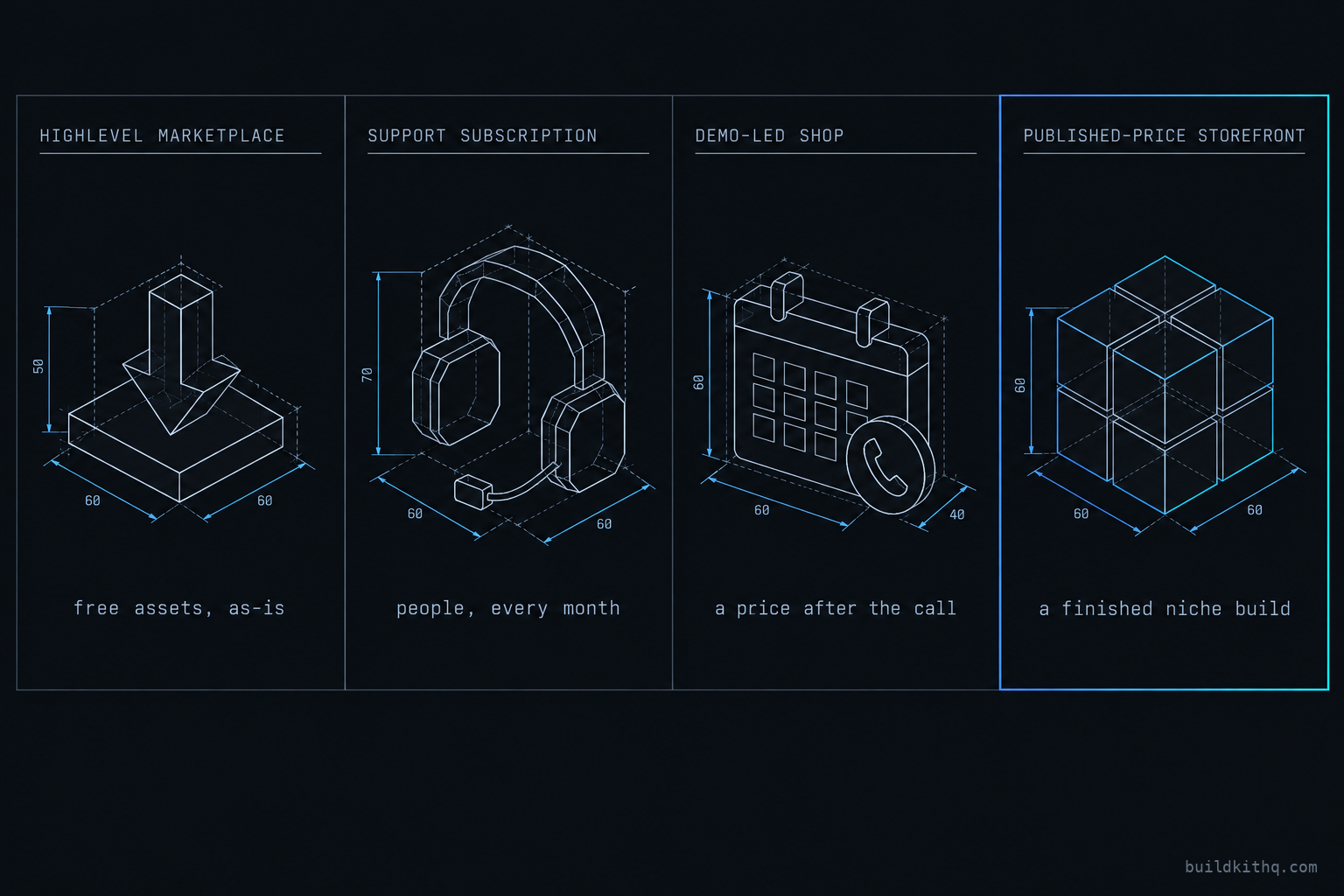
HighLevel's marketplace, a support subscription, a demo-led shop, and a published-price storefront. Four ways to source a GHL build, judged on eight things.
The tab you keep coming back to is a free snapshot you imported last Tuesday for a new roofing client. It loaded. The workflows are all there in the builder, sitting in neat folders. Then you opened one and it referenced a custom value called {{company.booking_link}} that does not exist in the account, so the confirmation text it sends is a broken URL. The calendar is pointed at a Google account that belongs to whoever built the thing. Nothing has an A2P registration behind it, so the first message you sent to your own phone to test it never arrived.
You have three other tabs open trying to fix this. One is a support subscription at $197 a month. One is an onboarding shop with no price on the page, just a button that books a call for next Thursday. One is a storefront selling a roofing build for a set number with the contents listed underneath it. Somewhere under all of it is the HighLevel bill you are paying whether any of these works or not.
The question is not which is cheapest. The question is which one actually hands you a finished account for this client by the weekend, because that is the thing you are short of. This is a guide to the four places that build comes from, what each one really gives you, and where each one leaves you holding the part nobody warned you about.
The four places a niche build actually comes from
Above your HighLevel subscription, the build itself reaches your account through one of four channels. They look similar on a spreadsheet and they are not similar at all, because each one is selling a different thing under the same word.
HighLevel’s own marketplace and the free snapshots
HighLevel has a built-in marketplace, and beyond it there is a whole informal economy of free snapshots shared in Facebook groups, affiliate bonuses and download links. You import a share link and the assets land in your sub-account.
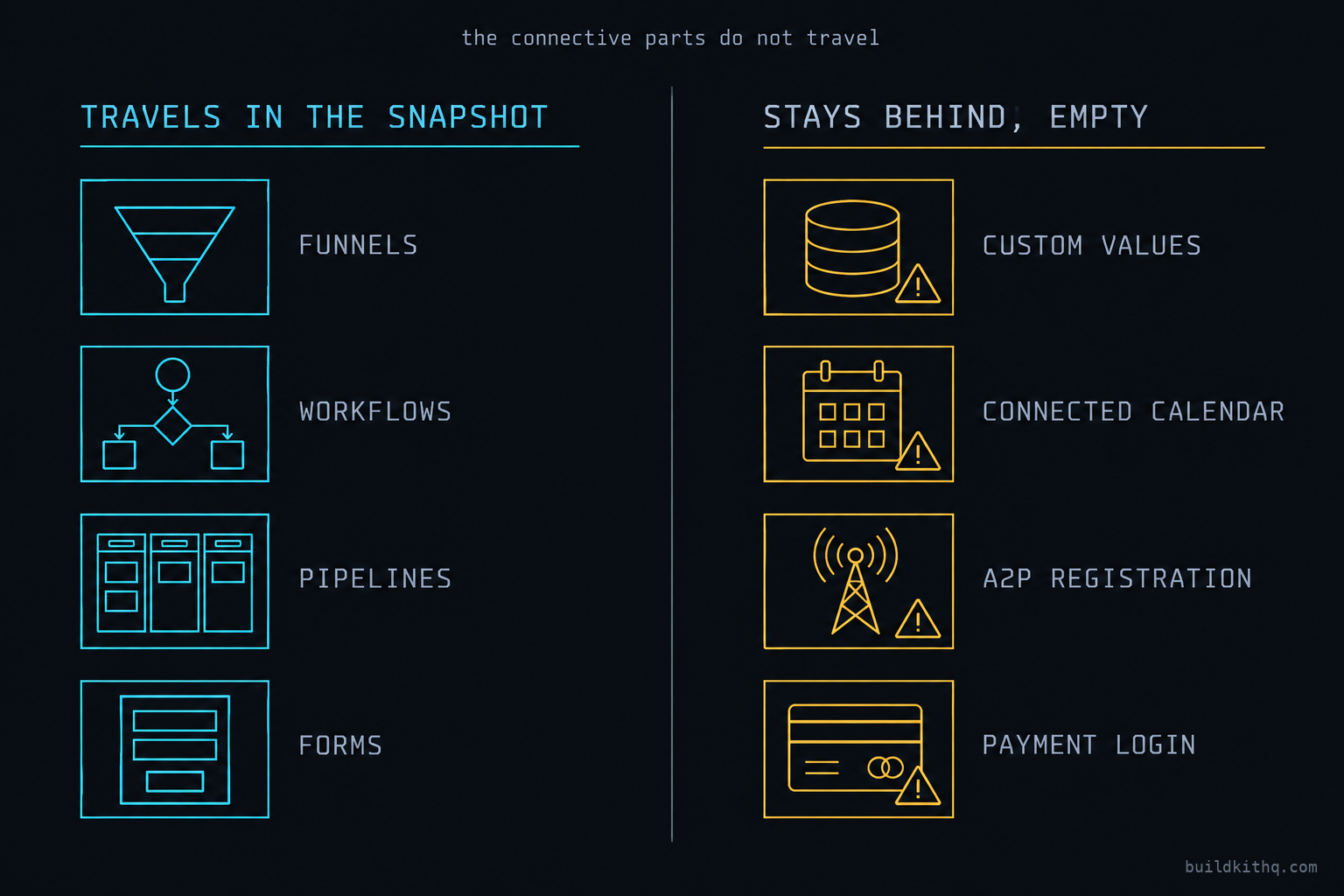
What you are actually buying here is nothing, in cash, and that is the tell. Most of these are community uploads with no obligation to be complete. The person who built it built it for their own account, exported it, and moved on. The funnels reference their custom values, the calendars carry their connected logins, and the A2P brand was theirs and does not travel. You inherit the half that exports cleanly and you rebuild the half that does not. For a simple lead form this is fine. For a full niche account it is a project disguised as a download.
A white-label support subscription
This is the model Growthable runs, and it is the one agencies most often mistake for a build. You pay monthly and real staff answer your clients’ tickets and live chat under your own brand. Growthable publishes its pricing: an Agency AI plan from $197 a month covering up to thirty-five sub-accounts, with a seven-day trial, and human white-label support on higher tiers where staff sit on the other end of the chat window.
Read the noun carefully. What a subscription buys is people, ongoing, not a finished account. It is genuinely valuable once you have live clients who ask questions, and it is worth its price for exactly that. It does not stand up the funnels, wire the workflows, or register the A2P brand for a brand-new roofing client. A support subscription answers the phone. It does not build the house the phone rings in.
A demo-led onboarding shop
Extendly and HL Pro Tools sit here. The pricing is not printed on a plain plan card the way HighLevel’s and Growthable’s are. You watch a demo or book a call, and the number arrives after the seller has your revenue in front of them. Independent comparisons of the white-label support shops describe both as onboarding-heavy options sold through a conversation, and the figures those comparison sites report for each one disagree with each other, which is what a price looks like when it is not published in one place.
I could not confirm a single current figure for either shop directly from the company this run, so I am not going to print one. That is the honest state of it, and it is also the point about this channel: you cannot rank it against the others until you have spent the call, and the call is the product’s first step, not a detour around it.
A published-price niche storefront
This is what BuildKitHQ is, so read the rest of this piece knowing that. A storefront sells one complete build per trade, prints the price, and lists what is inside before you reach the button. The roofing contractor build is a set number on the page. The salon and barber build sits at the low end of the range and the mortgage broker build at the top, and the full price list is on one page.
What you buy is the finished account for one trade: the funnels, the workflows, the pipelines, the calendars, the forms, the message copy and the AI Receptionist, wired together and made for that industry. On this site installation is free with every kit, and the price includes 10 hours of dedicated installation support, to be used within 12 days of purchase, which covers installing the kit, rebranding the site, A2P 10DLC registration and email domain setup. The clock on it is that there is no monthly clock. You pay once and the build is yours.
The eight things that actually separate them
Price is one column and it is not the important one. Here are the eight that decide whether a channel hands you a working account or a Saturday of repairs.
| What matters | HighLevel marketplace / free | Support subscription | Demo-led shop | Published-price storefront |
|---|---|---|---|---|
| Is the price published | Free or listed | Yes, from $197/mo | No, book a call | Yes, on the page |
| What you actually get | Assets, as-is | People, ongoing | Onboarding plus support | A finished niche build |
| Built for your trade | Rarely | Not a build | Sometimes | Yes, per industry |
| Contents shown before you pay | No | N/A | After the call | Yes, listed |
| Who fixes a broken import | You | Your clients’ tickets | Their team, per plan | Included install support |
| A2P and deliverability handled | No | Guidance only | Varies | In the install hours |
| Recurring cost | None | Every month | Often annual | None, one-time |
| Time to a live account | A weekend of repair | You still build it | Weeks, demo first | About a business day |
Read the table by column, not by row. The free snapshot wins the price column and loses almost every other one. The subscription wins on ongoing help and does not build anything. The demo-led shop can be strong on hand-holding and costs you the ability to compare it before you commit. The storefront is the only column where “what you get,” “shown before you pay,” and “time to a live account” all line up, which is the combination an agency owner short of a weekend is actually shopping for.
The word that does the damage across this table is “snapshot,” because all four use it and only two of them mean a finished build by it. A free download is a snapshot. A support plan is not, and calls itself one in the marketing anyway. Keep the columns straight and the marketing stops mattering.
Where each channel quietly fails you
Every one of these can leave you holding a part you did not know was missing. Here are the four failures that come up most, what you see when they happen, and how to get out of each.
The free snapshot that was built for someone else’s account
You import the share link, everything appears, and you assume it works because it is all there. Then a client’s confirmation text goes out with a dead link in it, because the workflow references a custom value that lived in the builder’s account and not yours.
What you see: a full, tidy set of workflows and funnels that looks complete in the builder. What is actually wrong: the connective tissue is missing. Custom values, connected calendars, connected payment accounts and the A2P registration do not travel inside a snapshot, so the parts that make the account send and book are exactly the parts you inherit empty. The fix: before you promise a client anything, open one workflow and trace a single message from trigger to send. If it references a custom value that is blank, or a calendar that is not yours, treat the whole snapshot as a starting frame you have to finish, and price the finishing in hours. Our own guide on why an imported account fires but nothing sends walks that trace end to end.
The subscription you bought expecting a build
You saw $197 a month next to a storefront’s one-time number, the monthly one felt smaller, and you signed up assuming it would produce the roofing account. Two weeks in, your clients can get their tickets answered and you still have an empty sub-account, because the plan never promised to build anything.
What you see: a low monthly number attached to the word “support” and a lot of GoHighLevel branding. What is actually wrong: you bought the answer desk, not the thing it answers questions about. The fix: decide first whether you need the build or the help, because they are different purchases. Buy the subscription when you have live clients generating questions. Buy or build the account when the account does not exist yet. Many agencies end up paying for both, on purpose, once they understand they are two things.
The demo that anchors before it quotes
You book the call to get a number, and the first twenty minutes are about your agency’s revenue and your client count, not about the work. By the time a figure appears it is sized to what you can pay, and there is no published price to check it against.
What you see: a friendly conversation about finding the right fit for you. What is actually wrong: the absence of a published number is doing a job, which is to let the quote be set against your budget rather than against the build. The fix: write your own ceiling down before the call and do not move it during the call. If a bundle is annual, divide it back to a monthly figure and set that beside the subscription and the one-time kit before you agree to anything. A price a seller will not put in writing before the call is information about the price, and it is rarely that the price is low.
The build you cannot resell the way you assumed
You buy a snapshot, deliver it to a client, and then try to reuse it for the next client in the same trade, only to find the license did not cover that, or the assets carry the seller’s branding in places you cannot fully strip. The margin you counted on across ten clients was priced on one.
What you see: a build you paid for and assumed you owned outright. What is actually wrong: resale rights and rebranding scope vary by seller and are easy to skim past at checkout. The fix: before you buy anything you plan to deploy across clients, confirm two things in writing: that you can reuse it per client, and that every visible surface can carry your brand and not the seller’s. On this site rebranding the site is part of the included install hours, and the kit is yours to deploy, but never assume that is true everywhere. Ask the resale question out loud before the money moves.
The year-one arithmetic, on one clock
Here is what each channel costs across a year for one new client sub-account, with the assumptions printed so you can drop your own in. This is the money math the pricing guide works through in full; this version just lines the four channels up side by side.
Assumptions, stated so you can swap them: one agency on HighLevel Unlimited at $297 a month, standing up one new client account in a defined trade. Prices are the published figures I could confirm as of 18 September 2026. Monthly plans are counted at twelve months for a year-one number. Usage fees for texts, calls and AI are left out, because they land on you the same way under every channel and vary by volume. Substitute your real plan and your real client count and the ranking can move, which is the whole reason to write it down.
Start with the floor. HighLevel publishes three plans: Starter at $97 a month, Unlimited at $297 a month, and Agency Pro at $497 a month, each with a 14-day free trial. For an agency running client accounts, Unlimited is the working plan, so the floor is $297 a month, about $3,564 across a year before you buy a single funnel. That number is the same under all four channels, which is exactly why it should not decide between them.
Now the build layer on top of the floor:
- The free snapshot costs nothing in cash and a repair window in time. If finishing a half-built import takes you the better part of a working week, the real cost is that week times your billable hour, and it is invisible until you write it down.
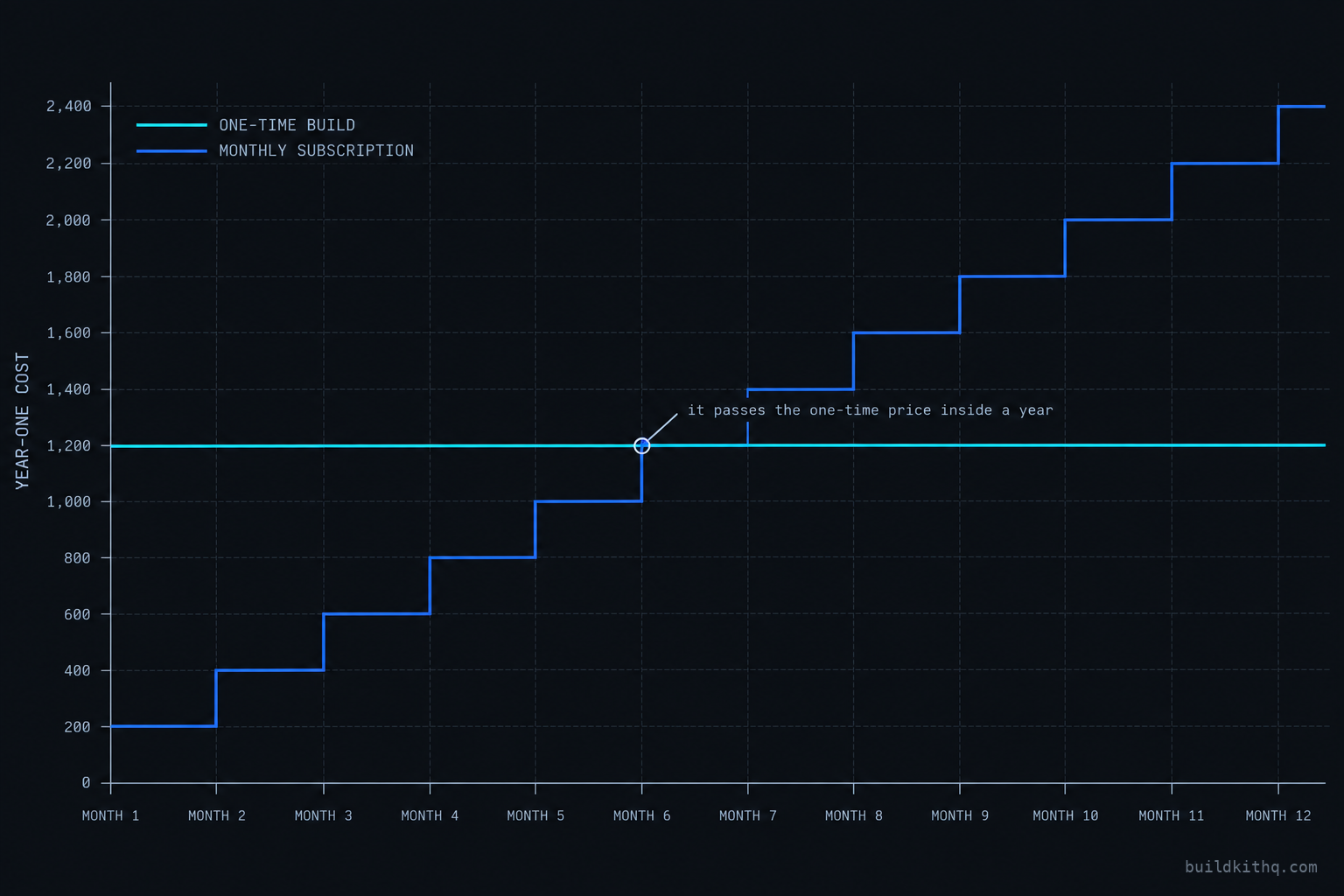
- The support subscription starts at $197 a month, which is $2,364 across a year, and it renews. It is a recurring line that never buys the build, so if you also need the account built, this number sits on top of one of the others, not instead of it.
- The demo-led shop I cannot put a confirmed figure against this run. It tends to be annual and set on the call, so budget it as one large number you divide back to a monthly rate before you commit.
- The published-price kit is a one-time number. On this site the niche builds run from $875 at the low end to just under $2,400 at the top, paid once, with the install support included in the price and nothing renewing.
Put those on the same clock and the comparison that felt hard on the glance gets simple. A recurring $197 a month passes any one-time kit in the range inside a single year, and it still has not built the account. The free snapshot is only free if your time is worth nothing, which for an agency owner who bills by the hour it is not. The one-time build is the only line that stops going up after you pay it.
Which source fits which agency
The right channel depends on what you are actually short of, so match the channel to the shortage.
If you are short of cash and long on time, and the account is simple, the free snapshot is a reasonable start as long as you trace the send path yourself before a client sees it. If you are short of nothing except client support once accounts are live, the subscription is the right buy, and it is the wrong buy for a build. If you want heavy hand-holding and onboarding and you are willing to spend a call to learn the price, the demo-led shop can fit, provided you hold your ceiling. And if you are short of a weekend and want a finished, trade-specific account you can rebrand and hand over fast, the published-price storefront is the column where the things you need line up. If you would rather hand the whole install to someone else, that is our done-for-you setup, and the whole reason it exists is that the free route is rarely as cheap as it looks.
The objections, including the one against us
If this piece only argued for buying from a storefront it would not be worth your time. Here are the strongest arguments against it, answered straight.
“A free community snapshot is good enough, I have finished plenty of them.” Sometimes it is, and if you can reliably finish one you are ahead of most. The objection holds for simple builds and for operators who genuinely enjoy the rebuild. It stops holding the moment the repair time exceeds what a finished build costs, which for a full niche account and an agency owner billing real rates happens fast. The honest version is not “free is bad,” it is “free is priced in hours, so count the hours before you call it cheap.”
“Why pay a storefront when a subscription is cheaper per month?” Because they are not the same purchase, and the per-month framing hides it. A subscription is a recurring cost that buys support and never buys a build. A one-time kit is a fixed cost that buys the build and never renews. If you only compare the monthly number you will keep paying it for years and still have to source the account somewhere. Compare what each one actually delivers first, then compare the money.
“How is your storefront different from every other paid snapshot shop?” Two things you can check without trusting us. The price is on the page, not behind a call, so you can rank us against anyone before you talk to a human. And the contents are listed before you buy, so you can see the funnels, workflows, pipelines and message copy that ship for your trade rather than a count with the details hidden. If a paid shop will not show you those two things, that is the comparison, and it is one you can run in a browser tab in five minutes.
“I already pay for HighLevel, isn’t the snapshot redundant?” No, and this is the confusion the whole guide is built to clear. HighLevel is the platform the build lives in. A snapshot is the build. Paying for the platform gives you an empty account with every tool available and nothing configured. The snapshot is what turns that empty account into a working one for a specific trade. You are paying for the room either way; the snapshot is the furniture.
The tab you keep coming back to, the free one with the broken confirmation link, is not a bargain. It is a preview of the work the other three channels either do for you, help you with, or hand you finished. Once you know which channel does which, the roofing account is a decision you can make in an afternoon instead of a weekend.
Quick answers
HighLevel's marketplace and the free snapshots that circulate are mostly community uploads with no completeness guarantee, so you inherit whatever the author left unfinished. A paid storefront sells a build made for one trade, lists its contents before you buy, and stands behind the install. You pay for the second because the first often costs a weekend to repair.
No. A support subscription like Growthable buys people who answer your clients under your brand, not a build. Its Agency AI plan starts at $197 a month for up to 35 sub-accounts. That is genuinely useful once you have accounts to support, but it does not stand up the funnels, workflows and pipelines. Those you still have to buy or build.
A demo-led sale lets the seller set the number against your revenue rather than against the work. It is not automatically a trick, but you cannot compare it to a published price until you have spent the call. Read a quote-only offer as a price you do not know yet, and do the division of any annual bundle before the call, not during it.
Installation is free with every kit, and you get 10 hours of dedicated installation support, to be used within 12 days of purchase. Those hours cover installing the kit, rebranding the site, A2P 10DLC registration and email domain setup. Third-party integrations and custom software development are quoted separately and are never in the hours.
Keep reading
What a finished GoHighLevel account does with a lead
A lead moves through five stages in a finished GoHighLevel account. Here is what each stage is wired to, and the handoffs where a half-built one drops it.
Read itThe AI receptionist in your kit answers, but never books
An imported kit's AI receptionist replies around the clock and books no one. Here is the booking path underneath, the four places it breaks, and the fix.
Read itThe four ways to catch a lead your client's phone missed
A missed call is a lost client. Compare the GoHighLevel AI Receptionist, a human VA, missed-call text-back and voicemail on the eight things that matter.
Read it