The break-even math on a kit you install for clients
A one-time GoHighLevel kit stops costing after you pay it. A monthly support plan does not. Here is the break-even math on a kit you install for clients.
It is Thursday and a construction company signed with you yesterday. They want to be live Monday. You have three browser tabs open. One is an empty HighLevel sub-account, blinking at you. One is a construction company kit with a price on it. One is a white-label support plan that bills $549 a month and wants a $199 setup fee before it answers a single ticket.
You are not trying to decide whether the kit price is a lot of money. You know what it is. You are trying to decide whether it comes back, and how fast, and whether buying beats the two days you would otherwise spend building the account from empty while the client watches the calendar.
That is a different question from “what does it cost,” and almost every pricing guide answers the wrong one. Cost is the number on the sticker. Break-even is that number set against the hours the kit saves you and the installs you will get out of it. One is printed on the page. The other you have to work out, and it is the one that actually decides whether to click the button.
This guide is about that second number. It is the payback side of the purchase, and it is deliberately not the same piece as two others on this site. What each client takes out of your margin once you resell the kit is its own calculation, covered in reselling a GoHighLevel kit. What building the whole thing from empty actually costs in time is covered in how long it takes to build a snapshot yourself. This one does a single job: work out when the purchase price is recovered, so the sticker stops being the scary part of the decision.
What a kit is actually recovering
A kit does one thing to your week. It turns a from-empty build into an install. That sounds small and it is the whole argument, because the build and the install are not the same job and they do not cost the same.
A from-empty build means wiring funnels, workflows, pipelines, calendars, forms and the message copy for one trade, in the right order, and then testing all of it before a client ever sees it. An install means importing a file that already has those parts wired and tested, pointing them at this client’s account, and spending your time on the handful of things that are genuinely client-specific. The kit does not remove the install. It removes the build. The money you are weighing buys back the difference between those two jobs, and that difference is where break-even lives.
There are three distinct things the kit recovers, and counting all three is what separates a real break-even from the one agencies do in their head and get wrong.
The hours you do not spend building
The first and largest is time. A niche build done properly, with the workflows tested and the message copy written rather than left as placeholder, is the better part of a working week. Priced at your real billable rate, that week is almost always worth more than the kit. This is the hour that agencies refuse to count, because it does not appear on a card statement, and it is usually the single biggest number in the whole calculation.
The weeks of client billing you do not lose
The second is less obvious and sometimes bigger. A client who goes live Monday starts paying you Monday. A client who waits while you build from empty starts paying you whenever the build is done. If buying a kit moves a go-live date forward by two weeks, and that client is on a retainer, the kit just bought you two weeks of billing you would otherwise have lost to the build. That recovered revenue is real and it belongs in the math, even though no pricing page mentions it.
The second install, and every one after
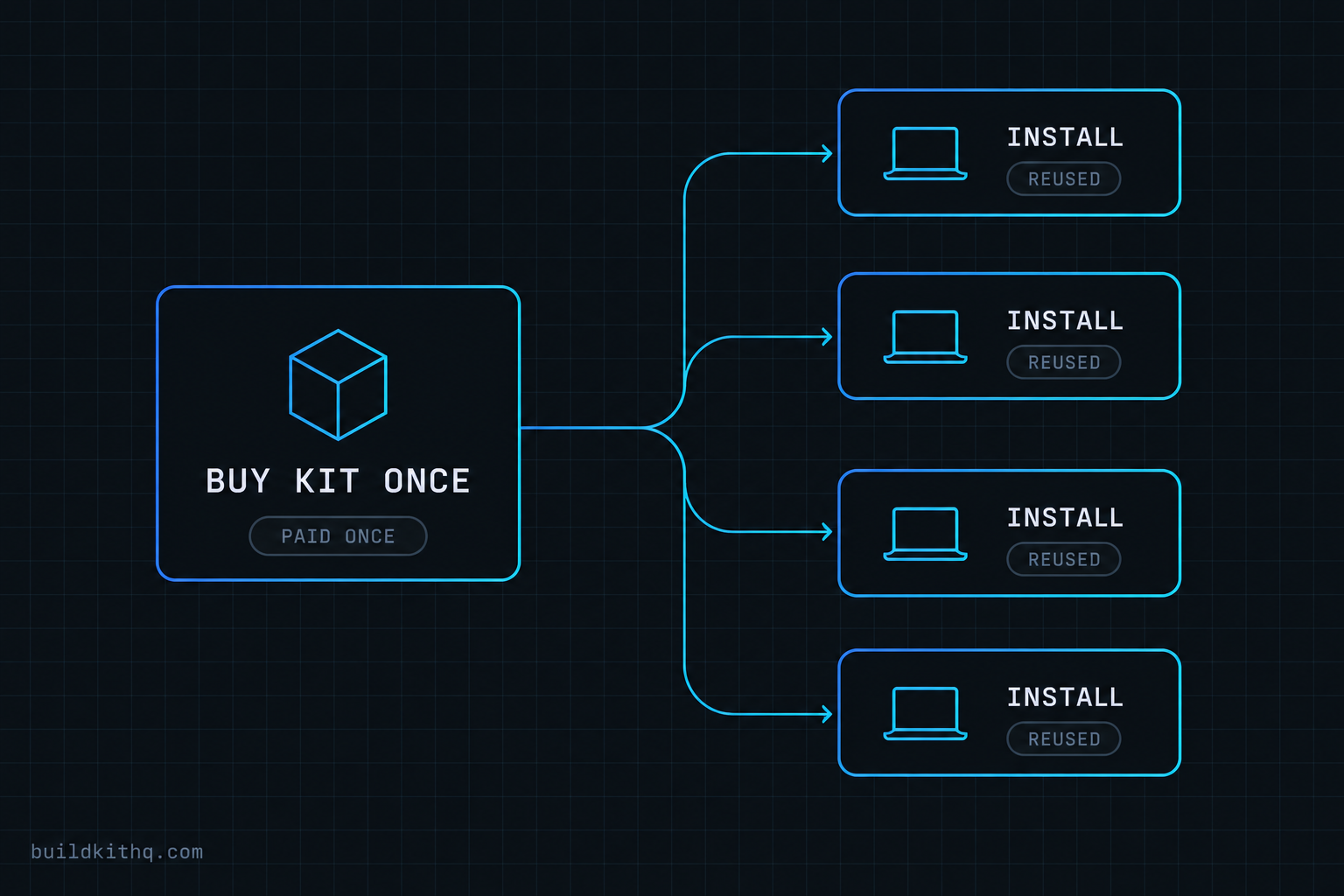
The third is reuse, and it is the one that turns a decent purchase into an obvious one. You buy the kit once. You install it for this construction client, and then for the next one, and the one after that. The price does not repeat. Every install after the first carries no purchase cost at all, only the install time, which is a fraction of the build time you already avoided. One trade, several clients, one sticker. The kit pays for itself on the first install if your rate is honest, and then keeps paying on every install after that for free.
Underneath all three sits a cost that is not part of any of this. HighLevel publishes its plans, and for an agency running client sub-accounts the working plan is Unlimited, at $297 a month as of October 2026, which is $3,564 across a year before you have bought a single funnel. Paying annually knocks roughly 17 percent off that, and every plan carries a 14-day free trial, but the figure you budget for the year is the one that matters here. That number is the same whether you buy the kit, rent a support team, or build everything yourself. It is the floor under every option, so it is noise in the comparison between them and a hard line in your monthly budget. Keep it in the budget. Keep it out of the break-even. A comparison that quietly folds the platform into one option and not the others is comparing a car to a car payment.
What the kit delivers inside that account is the part a client pays you to run: appointment reminders and no-show recovery, a nurture campaign, review automation, an AI Receptionist and an AI Chatbot, forms and surveys, custom values and custom fields wired to the rest. It is built toward the kind of targets these are designed around, a 70 percent no-show recovery target and five to ten reviews a month, written as design targets for the build and not as results I am promising your client will hit. Those are the outcomes the client is retaining you for, which is why moving their go-live forward has a dollar value.
The two clocks, and why they decide everything
Every option you are weighing runs on one of two clocks, and the clock matters more than the number.
A one-time price has no clock. You pay it, you import the file, and the number is done. It does not renew on the first of the month and it does not climb if you keep the account for three years. A kit is priced this way. The full price list runs from a low end around $875 for the simpler trades to a little under $2,400 at the top, and the number on the page is the number you pay, once.
A subscription runs on a monthly clock that never stops. The white-label support plan in your third tab is a good example. Growthable publishes its support pricing: a white-label support plan at $549 a month plus a $199 setup fee, where real staff answer your clients’ tickets and live chat under your brand, with higher tiers at $649 and $899 a month that add onboarding hours. That is a genuine service and it is not a build. It is a team, rented by the month, and its true size is the monthly figure times the number of months you will run it, which is a much larger number than the one on the card.
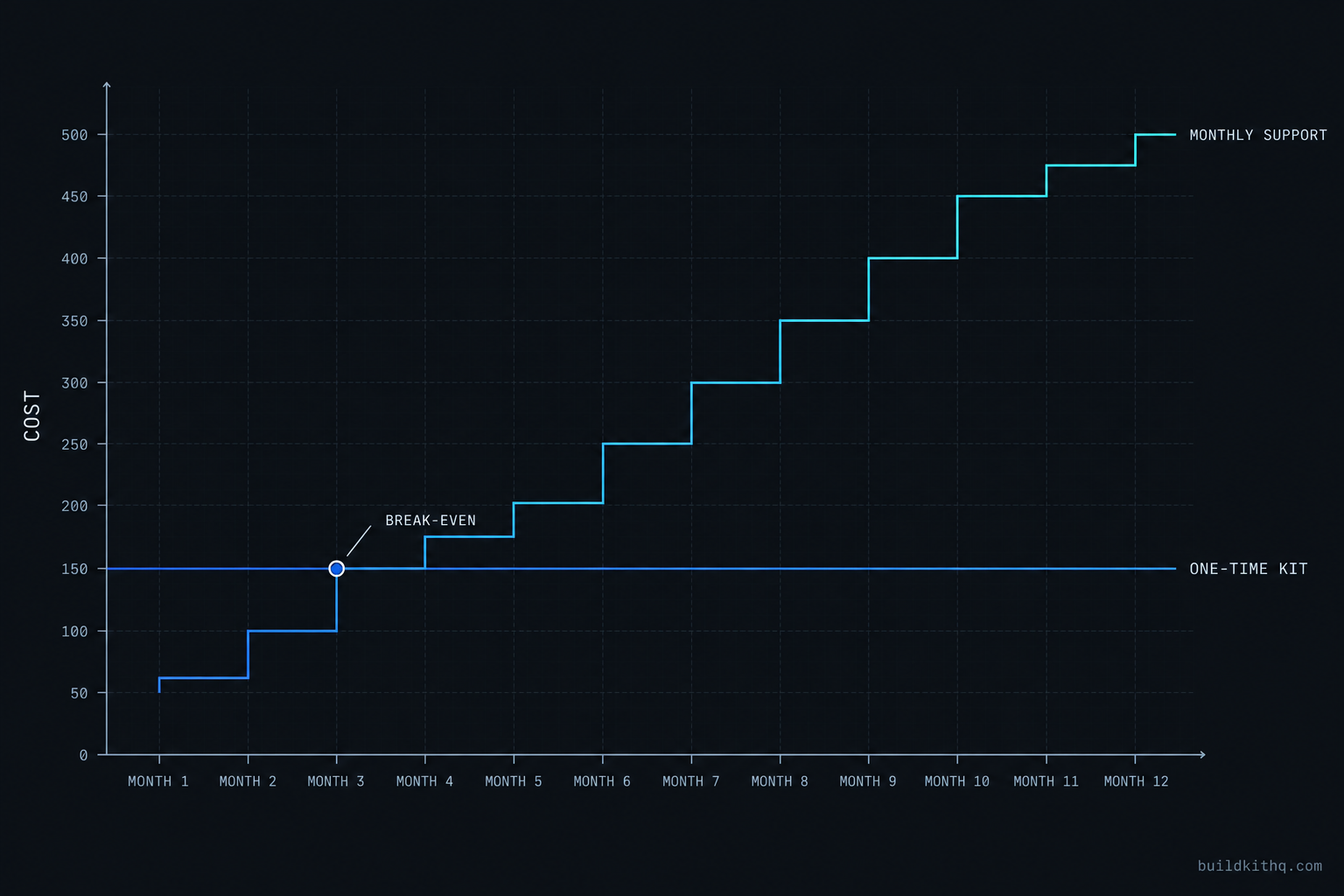
Break-even is just the point where these two clocks cross. Against building from empty, the kit breaks even the moment the hours it saves, priced at your rate, pass the sticker. Against renting a team, the kit breaks even the month the subscription’s running total passes the kit’s one-time price, after which the subscription keeps billing and the kit is already paid. Both crossings are easy to compute once you stop comparing a shape to a shape and put everything on the same clock.
Where the break-even math goes wrong
Five mistakes turn a sound calculation into a wrong one. Each is a case of leaving a real number out, or putting a fake one in.
Counting only the first install
What you see: the kit costs its sticker, you install it once, and you judge the purchase on that single client. What is actually wrong: you threw away the reuse, which is the kit’s whole point. A kit bought for one trade installs for every client in that trade, and the price never repeats. The fix: divide the purchase price across the number of clients you realistically expect in that niche over a year or two. On the second client the kit costs half what the sticker said. On the fifth it costs a fifth. Judge it across the installs you will actually get, not the one in front of you.
Subtracting the platform fee that is there either way
What you see: the kit plus the HighLevel subscription as one lump, which makes the kit look like it costs $297 a month more than it does. What is actually wrong: the platform fee is there whether or not you buy the kit. Building from empty does not avoid it. Renting a support team does not avoid it. Folding it into the kit’s payback double-counts a cost you were always going to pay. The fix: budget HighLevel Unlimited as a fixed line that never moves, then run the break-even in the layer above it. The $297 is real and it is yours regardless, which is exactly why it cannot be charged against one option in a comparison between options.
Pricing your own time at zero
What you see: building it yourself is free, because no money leaves your account. What is actually wrong: your time is the most valuable thing you sell, and calling it free makes every build look cheaper than buying and makes break-even look impossible to reach. The fix: put a real number on your hour. Use what you bill a client, or at least what you would pay someone to do the work. The moment your time has a price, the hours a kit saves have a price too, and the break-even appears. An agency owner who prices their own time at zero will always conclude they should build everything themselves, right up until the week they run out of weeks.
Comparing a one-time price to one month of a subscription
What you see: a kit’s sticker next to $549 a month, and the monthly number looks smaller, so it wins the glance. What is actually wrong: you compared the entire lifetime of one thing against a single month of the other. Keep the subscription a year and it is $6,588, keep it two and it is over $13,000, while the kit you skipped is still its one-time price and always will be. The fix: multiply every monthly figure by the number of months you will realistically run it before you set it beside a one-time number. The shapes have to match before the sizes mean anything.
Assuming each client’s setup is free the second time
What you see: once you own the kit, every client is a quick import and nothing else. What is actually wrong: some of the setup does not amortize. Each client needs its own A2P 10DLC brand registered before a text will send, its own domain and email configured, its own branding swapped in. That work repeats per client whether you bought a kit or built from empty. The fix: separate the costs that spread across clients, like the kit price, from the costs that repeat per client, like registration and rebranding. With a BuildKitHQ kit the repeating work is inside the included support: 10 hours of dedicated installation support, to be used within 12 days of purchase, covering the install, the rebrand, A2P 10DLC registration and setup, and email domain setup. If you would rather hand the registration off every time, A2P 10DLC registration is a standalone service at a fixed per-brand price. Either way, put the per-client number in its own line so it does not hide inside the one-time one.
The arithmetic, with your own rate in it
Here is the whole thing on one clock, for one new client sub-account, so the options finally sit still next to each other.
Assumptions, printed so you can swap your own in: one agency, on HighLevel Unlimited at $297 a month, standing up one construction client. The platform floor is left out of the table because it is identical under every option and belongs in your monthly budget instead. Prices are the published figures as of 14 October 2026. The construction kit is quoted at its live price. The monthly support plan is Growthable’s published white-label support rate. The build-from-empty row uses your own billable rate and the hours a from-empty build genuinely costs you, which is a number only you have. Substitute your real figures and the crossing points move, which is the point.
| How you stand up the client | Billing shape | To put client #1 live | Client #2 | Running cost by month 12 |
|---|---|---|---|---|
| Buy the kit once | One-time | the kit price | an install, not a rebuild | the kit price, and it stays there |
| Rent white-label support | Monthly, $549 plus $199 setup | $748 in month one | billed again, every month | $6,787 |
| Build it from empty | Your hours | your rate times the build hours | your hours again, unless you saved your own snapshot | your rate times the build hours |
Read the crossings, not the stickers. Take the construction kit at $1,475 and a billable rate of $100 an hour, and suppose a from-empty build in a trade you know costs you twenty focused hours once the testing and the copy are done honestly. That build is worth $2,000 of your time. The kit is $1,475. It has paid for itself on the first install, with change, and the second client is an import rather than a rebuild, so the kit costs nothing on client two and nothing on every client after. Against the rented team, the running total passes the kit price in the third month: $748 in month one, $1,297 by month two, $1,846 by month three, climbing past the one-time $1,475 and never coming back down.
That does not make the subscription wrong. It makes it a different purchase. The support plan is renting a team to answer your clients’ tickets all year; the kit is buying the build once and keeping it. If you genuinely need a team on live chat under your brand, the subscription earns its recurring fee and a kit does not replace it. If what you need is the account built, installed and handed over, you are renting a team by the year to do a job that finished in week one. Price both, on the same clock, and the one that wins is usually the one that was quietly winning before you opened the spreadsheet.
The objections worth taking seriously
Four arguments push back on all of this, and the strongest versions are worth answering straight.
“Break-even assumes I will resell it, and I only have one client.” Then run it as a single install, which the math above already does. Even on one client, the hours a from-empty build costs you, priced at your real rate, usually exceed the kit price, so the kit comes back on that one install. The reuse makes the case stronger, it does not make the case. If your rate is honest and your week is not free, a complete kit is the cheaper way to stand up even a single account.
“A subscription includes ongoing support. A kit leaves me on my own.” This is the fair one and it is half right. A support subscription buys an ongoing team and a kit is not that. But a kit is not nothing after purchase either. Every BuildKitHQ kit includes 10 hours of dedicated installation support, to be used within 12 days of purchase, and those hours cover the install, the rebrand, A2P 10DLC registration and setup, and email domain setup. The difference is honest: the subscription is support that renews forever, the kit is a fixed allowance inside a window, and after the window further work is quoted and paid. If your clients generate a constant stream of tickets, the recurring fee earns itself. If they do not, you are paying for a team to sit idle.
“I could build it myself and keep the cash.” Sometimes you should, and this is the argument against buying from us that I will make for you. If you know the trade cold, you have built its account structure before, and you have a clear week with nothing billable competing for it, build it. You will get exactly what you want and you will learn the account in a way buying never teaches, and you can save your own version and reuse it like a kit. Buy a kit when the opposite is true: when the week is not free, the trade is new to you, or a client is waiting and the real alternative is a rushed build at midnight. The break-even is not a claim that you cannot do it. It is the number that tells you whether doing it is worth your week.
“Your kit costs more than a cheap one I found.” It might, and price and completeness are the same conversation. A cheaper or free snapshot that arrives half-wired is priced in repair hours instead of dollars, and those hours land the week a client is waiting to go live. A build under the roughly $850 mark that a complete niche kit tends to start at is usually leaving the wiring out, which is the part that takes longest to rebuild. Price the cheap one at its sticker plus your estimate of the rebuild time, then compare the totals. A snapshot that never has to be rebuilt breaks even sooner than a cheap one that does, even when the cheap one started lower. A salon and barber build at the low end of the range is still a complete, tested account, which is the thing that actually recovers your time.
None of this is an argument that a kit is always the answer. It is an argument that the sticker is the wrong number to decide on. Put your real rate on your hours, divide the price across the installs you will actually get, keep the platform floor in its own line, and set every monthly figure on a full year before you rank it. Do that and the break-even stops being a guess. Most of the time it has already happened by the end of the first install, and the only thing left to decide is which trade you buy for next. If you would rather not run any of this yourself, the done-for-you build exists for exactly that, and it folds the kit into a fixed price so the break-even question becomes someone else’s to answer.
Quick answers
It depends on your billable rate and whether you reuse it. Against building from empty, a kit often comes back on the first install, because the hours it saves, priced at your real rate, exceed the sticker. Against a monthly support plan, a one-time kit is cheaper by around the third month and stays there, because the kit stops billing and the subscription does not.
No. HighLevel Unlimited runs $297 a month whether you buy a kit, rent a support team, or build the account yourself at 2am. It is the same floor under every option, so it belongs in your monthly budget, not in the comparison between them. Subtracting it from the kit's payback double-counts a cost you were always going to pay.
Installation is free with every kit, and you get 10 hours of dedicated installation support, to be used within 12 days of purchase. Those hours cover installing the kit, rebranding the website, A2P 10DLC registration and setup, and email domain setup in HighLevel. Third-party integrations and custom software development are quoted separately and are never in the hours.
Rarely. A cheaper or free snapshot that arrives half-wired bills you in repair hours, and those hours land the week a client is waiting to go live. Price the cheap one at its sticker plus your estimate of the rebuild time, then compare that total. The complete kit is often the one that comes back sooner, because it comes back without a rebuild.
When you know the trade cold, you have built its structure before, and you have a clear week with nothing billable competing for it. In that case the hours are cheap to you and building is the rational call. Buy a kit when the week is not free, the trade is new to you, or a client is already waiting and a rushed build is the alternative.
Keep reading
What a finished GoHighLevel account does with a lead
A lead moves through five stages in a finished GoHighLevel account. Here is what each stage is wired to, and the handoffs where a half-built one drops it.
Read itThe AI receptionist in your kit answers, but never books
An imported kit's AI receptionist replies around the clock and books no one. Here is the booking path underneath, the four places it breaks, and the fix.
Read itThe four ways to catch a lead your client's phone missed
A missed call is a lost client. Compare the GoHighLevel AI Receptionist, a human VA, missed-call text-back and voicemail on the eight things that matter.
Read it